Have you ever used the word “describes” too many times in the same essay or blog post?
For example, you may write, “The author describes the room,” and then use “describes” again in the next sentence. A better word can make your writing sound fresh and clear.
The word describes means to tell what someone or something is like. You can describe a person, place, thing, event, idea, or feeling.
Learning synonyms for describes gives you more ways to share details. Students can use them in essays. Bloggers and content writers can make their work more engaging.
Daily English users can also speak with more variety. This synonyms for describes guide gives you 30 useful choices, with simple meanings and examples.
Quick Answer Box:
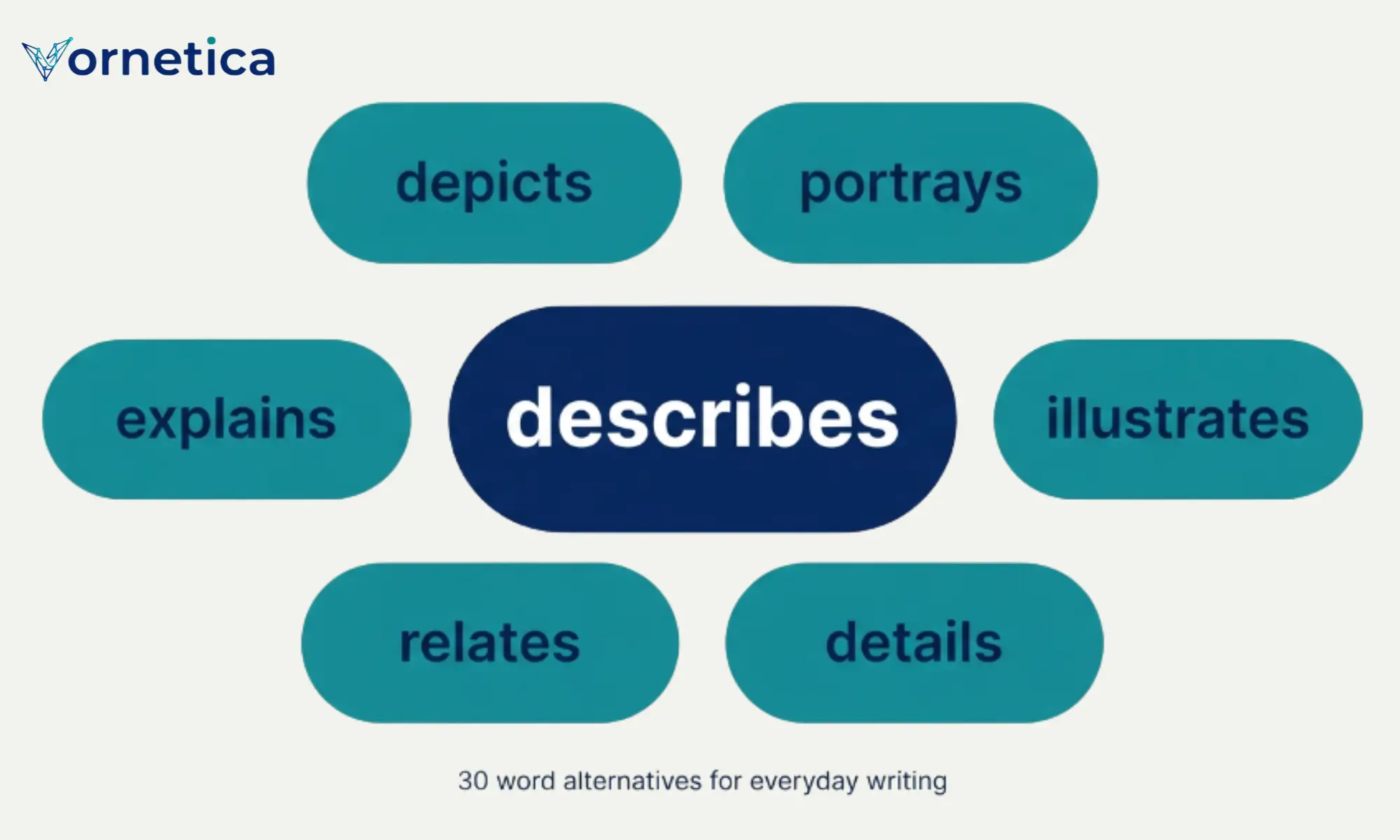
Another word for describes can be explains, portrays, depicts, details, or outlines. The best choice depends on whether you are talking about facts, appearance, events, or ideas.
Explains
Meaning: Explains means to make something clear or easy to understand.
Examples:
- The teacher explains the math problem.
- This guide explains how the app works.
Best Used When: Use it for ideas, facts, rules, or processes.
Portrays
Meaning: Portrays means to show someone or something in a certain way.
Examples:
- The movie portrays the hero as brave.
- The book portrays village life in a simple way.
Best Used When: Use it in books, movies, art, and character writing.
Depicts
Meaning: Depicts means to show or represent someone or something.
Examples:
- The painting depicts a quiet beach.
- The photo depicts life in a small town.
Best Used When: Use it for pictures, art, photos, stories, and visual scenes.
Details
Meaning: Details means to give facts or information about something.
Examples:
- The report details the main problems.
- She details her plans in the email.
Best Used When: Use it for reports, plans, events, and factual writing.
Outlines
Meaning: Outlines means to give the main points of something.
Examples:
- The teacher outlines the steps for the project.
- The report outlines the new company rules.
Best Used When: Use it for plans, reports, ideas, and formal writing.
Portrays
Meaning: Portrays means to present a person, place, or idea in a certain way.
Examples:
- The novel portrays the city as peaceful.
- The actor portrays a kind father.
Best Used When: Use it when discussing characters, stories, or media.
Illustrates
Meaning: Illustrates means to make an idea clear with an example or picture.
Examples:
- This story illustrates the value of kindness.
- The chart illustrates the rise in sales.
Best Used When: Use it in educational, technical, and formal writing.
Characterizes
Meaning: Characterizes means to show the main qualities of a person or thing.
Examples:
- The story characterizes Tom as honest.
- Her work characterizes the town as friendly.
Best Used When: Use it for people, characters, places, and ideas.
Presents
Meaning: Presents means to show or give information about something.
Examples:
- The article presents a simple solution.
- The speaker presents the facts clearly.
Best Used When: Use it in formal, academic, and professional writing.
Reveals
Meaning: Reveals means to show something that was not known before.
Examples:
- The letter reveals his true feelings.
- The test reveals a small problem.
Best Used When: Use it for hidden facts, feelings, results, or information.
Expresses
Meaning: Expresses means to show a thought, feeling, or idea.
Examples:
- The poem expresses deep sadness.
- Her face expresses joy.
Best Used When: Use it for feelings, opinions, ideas, art, and creative writing.
Shows
Meaning: Shows means to make something clear or visible.
Examples:
- The map shows the road to the village.
- His smile shows that he is happy.
Best Used When: Use it in casual speech and simple writing.
Reports
Meaning: Reports means to give information about an event or fact.
Examples:
- The news reports the latest storm.
- The paper reports a rise in prices.
Best Used When: Use it for news, events, facts, and formal information.
States
Meaning: States means to say something clearly and directly.
Examples:
- The notice states the new rules.
- The writer states his main point early.
Best Used When: Use it for facts, claims, rules, and formal writing.
Defines
Meaning: Defines means to explain the exact meaning of something.
Examples:
- The dictionary defines the word clearly.
- The teacher defines the term for the class.
Best Used When: Use it for words, terms, ideas, and academic topics.
Specifies
Meaning: Specifies means to give exact details about something.
Examples:
- The form specifies the required size.
- The guide specifies each step.
Best Used When: Use it for instructions, rules, requirements, and technical writing.
Summarizes
Meaning: Summarizes means to give the main points in a short way.
Examples:
- The final paragraph summarizes the story.
- She summarizes the meeting for her team.
Best Used When: Use it for books, meetings, reports, articles, and lessons.
Recounts
Meaning: Recounts means to tell about past events in order.
Examples:
- He recounts his trip to the mountains.
- The book recounts her childhood memories.
Best Used When: Use it for stories, memories, trips, and past events.
Narrates
Meaning: Narrates means to tell a story or describe events.
Examples:
- The author narrates the story in first person.
- She narrates what happened that night.
Best Used When: Use it for stories, books, films, and spoken accounts.
Depicts
Meaning: Depicts means to represent something through words, pictures, or art.
Examples:
- The mural depicts local farmers.
- The novel depicts a busy city.
Best Used When: Use it for art, images, novels, and visual scenes.
Represents
Meaning: Represents means to stand for or show something.
Examples:
- The logo represents the company.
- The color blue represents peace.
Best Used When: Use it for symbols, ideas, brands, and visual meaning.
Demonstrates
Meaning: Demonstrates means to show clearly how something works or happens.
Examples:
- The video demonstrates the new tool.
- The teacher demonstrates the simple experiment.
Best Used When: Use it for lessons, skills, processes, and technical topics.
Clarifies
Meaning: Clarifies means to make something easier to understand.
Examples:
- The note clarifies the new rule.
- She clarifies her point during the meeting.
Best Used When: Use it when removing confusion or making an idea clear.
Identifies
Meaning: Identifies means to name or point out someone or something.
Examples:
- The report identifies the main cause.
- The guide identifies three common mistakes.
Best Used When: Use it for problems, causes, people, objects, and key points.
Discusses
Meaning: Discusses means to talk or write about a subject.
Examples:
- The article discusses healthy study habits.
- The teacher discusses the story with us.
Best Used When: Use it for articles, essays, lessons, meetings, and conversations.
Addresses
Meaning: Addresses means to deal with a question, problem, or topic.
Examples:
- The report addresses the main issue.
- The blog post addresses common student questions.
Best Used When: Use it for problems, questions, concerns, and formal writing.
For example, writers who create articles about vocabulary may want to decide which synonyms fit best before choosing a word.
Covers
Meaning: Covers means to include or talk about a subject.
Examples:
- This lesson covers basic grammar.
- The report covers several key topics.
Best Used When: Use it for articles, lessons, reports, and broad topics.
Depicts
Meaning: Depicts means to show what a person, place, or thing looks or feels like.
Examples:
- The photograph depicts a crowded street.
- The artist depicts the sunset beautifully.
Best Used When: Use it mainly for visual or creative descriptions.
Evokes
Meaning: Evokes means to bring a feeling, memory, or image to mind.
Examples:
- The song evokes happy memories.
- The old house evokes a sense of peace.
Best Used When: Use it for emotions, memories, art, music, and creative writing.
Portrays
Meaning: Portrays means to show a person, place, or idea through words or images.
Examples:
- The film portrays life during the war.
- The writer portrays her as a strong leader.
Best Used When: Use it for films, books, characters, and creative work.
Describes in Detail
Meaning: Describes in detail means to give many clear facts about something.
Examples:
- The guide describes in detail how the machine works.
- She describes in detail what happened at school.
Best Used When: Use it when a subject needs a full and careful explanation.
Depicts Clearly
Meaning: Depicts clearly means to show something in an easy-to-understand way.
Examples:
- The diagram depicts the process clearly.
- The photo depicts the busy market clearly.
Best Used When: Use it for images, diagrams, charts, and visual explanations.
Comparison Table
| Synonym | Tone | Best Used In |
| Explains | Neutral | Writing/Speech |
| Portrays | Formal | Writing |
| Depicts | Formal | Writing/Technical |
| Details | Formal | Writing |
| Outlines | Formal | Writing |
| Illustrates | Formal | Writing/Technical |
| Characterizes | Formal | Writing |
| Presents | Neutral | Writing/Speech |
| Reveals | Neutral | Writing |
| Expresses | Neutral | Writing/Speech |
| Shows | Casual | Speech/Writing |
| Reports | Formal | Writing |
| States | Formal | Writing/Speech |
| Defines | Formal | Writing/Technical |
| Specifies | Formal | Technical/Writing |
| Summarizes | Neutral | Writing/Speech |
| Recounts | Formal | Writing |
| Narrates | Formal | Writing |
| Represents | Neutral | Writing/Technical |
| Demonstrates | Formal | Technical/Speech |
| Clarifies | Neutral | Writing/Speech |
| Identifies | Formal | Writing/Technical |
| Discusses | Neutral | Writing/Speech |
| Addresses | Formal | Writing |
| Covers | Neutral | Writing/Speech |
| Evokes | Creative | Writing |
| Describes in Detail | Neutral | Writing/Speech |
| Depicts Clearly | Neutral | Writing/Technical |
Learning related vocabulary can also help you choose stronger words when writing about events or actions. For instance, you can compare these choices with synonyms for created when discussing how something was made or formed.
Frequently Asked Questions
What is another word for describes?
Common alternatives include explains, portrays, depicts, details, and outlines. The best word depends on the sentence.
What is a formal synonym for describes?
Details, outlines, characterizes, and specifies can work well in formal writing. Choose the word that matches the exact meaning.
What is the difference between describes and explains?
Describes tells what something is like. Explains makes an idea, reason, or process clear.
What is a synonym for describes in an essay?
Good choices include explains, presents, discusses, illustrates, and outlines. Your choice depends on what the sentence is doing.
Can describes be used for people and places?
Yes. You can use describes for people, places, objects, events, feelings, and ideas. For example, “The writer describes the city.”
Practice Exercise
Fill in each blank with the best synonym from the list.
- The teacher _________ how to solve the problem.
- The painting _________ a quiet village near the sea.
- The report _________ the main causes of the problem.
- The final paragraph _________ the main points of the story.
- The speaker _________ his travel experience to the audience.
Answer Key
- explains
- depicts
- details
- summarizes
- recounts
Key Takeaways
Remember these useful points:
- Explains is great for making ideas clear.
- Depicts works well for pictures, art, and scenes.
- Portrays is useful for people, characters, and stories.
- Details gives clear facts and information.
- Outlines gives the main points of a topic.
- Choose a synonym based on the meaning and tone, not just the word itself.
Before finishing, you can also expand your vocabulary around actions and reactions by checking synonyms for complain. Using related words in different contexts can help you understand which synonym sounds most natural.
Conclusion
Learning synonyms for describes can make your writing more clear, natural, and interesting.
Words such as explains, depicts, portrays, details, and outlines give you more ways to share ideas.
They are useful in essays, blogs, emails, conversations, and creative writing. Try replacing “describes” with one suitable synonym each day.
With regular practice, choosing the right word will become easier. When you want to improve your vocabulary further, search for another word or synonym on the site.