You finish a long report. Your last heading says “Summary.” Again. Your last three reports ended the same way.
Here is a simple example. A student writes, “Here is a summary of the book.” It works, but it gets boring fast.
A summary is a short version of something long. It shares only the main points.Using synonyms for summary keeps your writing fresh.
Students use these words in book reports. Bloggers use them in post endings.
Content writers use them for client work. Everyone can use them in daily talk, like when you share a quick recap of a meeting or a short summary of a training program.
Quick Answer: What is another word for summary?
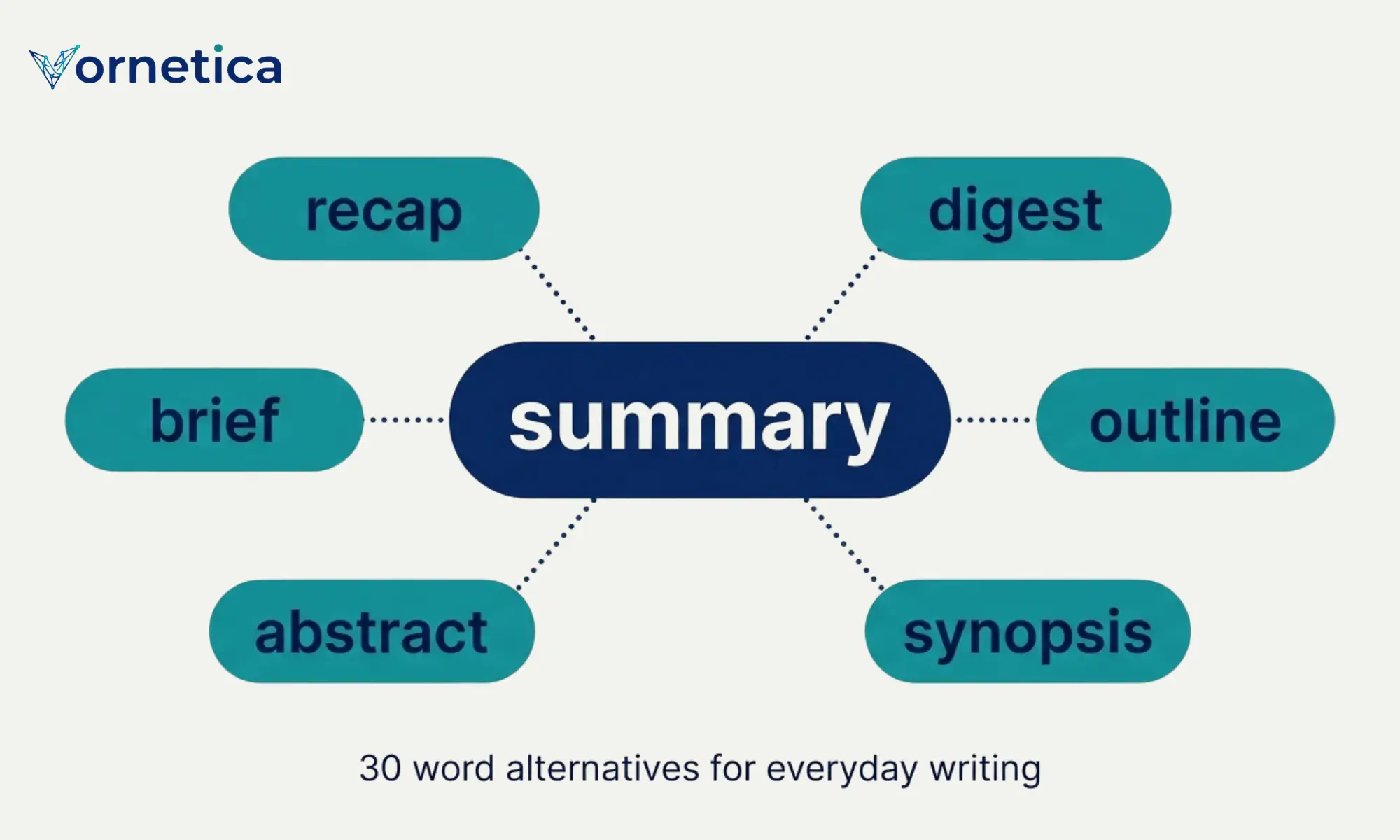
Another word for summary is a short version of the main points. Writers often use overview, recap, synopsis, abstract, or digest in its place.
Top 5 synonyms: Overview | Recap | Synopsis | Abstract | Digest
Overview
Meaning: A short look at the whole topic.
Examples:
- The teacher gave us an overview of the lesson.
- Read the overview before you start the course.
Best Used When: You want a neutral word for reports, even those written under pressure.
Recap
Meaning: A short repeat of what already happened.
Examples:
- Let me give a quick recap of yesterday’s talk.
- The show starts with a recap of last week.
Best Used When: You speak or write casually, such as for a weekly quota update.
Abstract
Meaning: A short note at the start of a paper that tells what it is about.
Examples:
- The abstract told me the study was about sleep.
- She wrote a 150-word abstract for her paper.
Best Used When: You write school or research papers.
Digest
Meaning: A short mix of the main parts of longer works.
Examples:
- I read the daily news digest on my phone.
- The weekly digest lands in my inbox on Monday.
Best Used When: You share news, emails, or newsletters.
Outline
Meaning: A plain list of the main points.
Examples:
- Write an outline before you write the essay.
- His outline had five clear parts.
Best Used When: You plan or sketch ideas before writing.
Synopsis
Meaning: A short story of what a book or movie is about.
Examples:
- The back cover has a short synopsis of the novel.
- Can you send me a synopsis of the film?
Best Used When: You describe books, films, or any case that sets a precedent.
Gist
Meaning: The main idea without small details.
Examples:
- I got the gist of what he said.
- Just tell me the gist of the story.
Best Used When: You talk casually, like after a sudden realization.
Brief
Meaning: A short paper that gives key facts.
Examples:
- The manager sent a brief about the new plan.
- Please read the brief before the call.
Best Used When: You work in business, news, or law.
Rundown
Meaning: A fast list of the main facts.
Examples:
- Give me a rundown of today’s tasks.
- She shared a rundown of the match.
Best Used When: You speak in a relaxed, friendly way.
Précis
Meaning: A very short, exact version of a text.
Examples:
- Our teacher asked for a précis of the poem.
- He wrote a précis in ten lines.
Best Used When: You write for school or formal tasks.
Review
Meaning: A short look back at key points.
Examples:
- We did a review before the test.
- The chapter ends with a quick review.
Best Used When: You teach or study.
Highlights
Meaning: The best or most important parts.
Examples:
- Watch the highlights of the game.
- Here are the highlights of our trip.
Best Used When: You share the top moments of an event.
Essence
Meaning: The most important part of something.
Examples:
- The essence of the story is kindness.
- She caught the essence of the speech.
Best Used When: You write in a thoughtful or creative style.
Sum-up
Meaning: A short end note that gathers the main points.
Examples:
- Her sum-up made the meeting clear.
- I wrote a short sum-up at the end.
Best Used When: You close a talk or an email.
Epitome
Meaning: A perfect short example of something bigger.
Examples:
- The poem is the epitome of her style.
- This letter is the epitome of good manners.
Best Used When: You write essays or praise something.
Condensation
Meaning: A shorter form of a longer text.
Examples:
- The magazine printed a condensation of the book.
- A condensation of the report fit on one page.
Best Used When: You write in a formal or technical way.
Abridgment
Meaning: A shorter copy of a book with parts removed.
Examples:
- I read an abridgment of the old classic.
- The abridgment is easier for kids.
Best Used When: You talk about books and reading levels.
Capsule
Meaning: A tiny summary packed into a few words.
Examples:
- The site gives a capsule of each movie.
- Read the capsule review first.
Best Used When: You write short reviews or blurbs.
Snapshot
Meaning: A quick picture of how things stand now.
Examples:
- The chart gives a snapshot of sales.
- This page is a snapshot of our year.
Best Used When: You share data or progress.
Wrap-up
Meaning: The last part that pulls things together.
Examples:
- The host did a wrap-up of the show.
- Our wrap-up took only two minutes.
Best Used When: You end an event, meeting, or video.
Roundup
Meaning: A list that gathers many items in one place.
Examples:
- Read this week’s tech roundup.
- She wrote a roundup of the best apps.
Best Used When: You blog or write news posts.
Résumé
Meaning: A short account of facts or events.
Examples:
- He gave a résumé of the case.
- The book has a résumé of each chapter.
Best Used When: You write in a formal or older style.
Sketch
Meaning: A rough short version of an idea.
Examples:
- He gave a sketch of his plan.
- Write a quick sketch of the topic.
Best Used When: You share early ideas.
Run-through
Meaning: A fast pass over the main points.
Examples:
- Let’s do a run-through of the steps.
- The coach gave a run-through of the rules.
Best Used When: You talk in a team or class.
Key Points
Meaning: The most important facts, listed simply.
Examples:
- Write down the key points from the video.
- The page lists key points in bullets.
Best Used When: You make notes or blog posts easy to scan.
Bottom Line
Meaning: The final, most important fact.
Examples:
- The bottom line is that we need more time.
- What is the bottom line of this plan?
Best Used When: You speak in business or give advice.
Distillation
Meaning: The best and purest part of a bigger idea.
Examples:
- The book is a distillation of his years of work.
- Her talk was a distillation of simple rules.
Best Used When: You write deep or creative pieces.
Compendium
Meaning: A short but full collection of main facts.
Examples:
- The guide is a compendium of easy recipes.
- He wrote a compendium of travel tips.
Best Used When: You write formal or reference content.
Thumbnail
Meaning: A very brief note about a topic.
Examples:
- The page gives a thumbnail of each author.
- Here is a thumbnail of the plan.
Best Used When: You need a tiny intro or quick profile.
Breakdown
Meaning: A list that splits something into small parts.
Examples:
- The teacher gave a breakdown of the topic.
- Send me a breakdown of the costs.
Best Used When: You explain numbers, steps, or plans.
Comparison Table
| Synonym | Tone | Best Used In |
| Overview | Neutral | Writing |
| Recap | Casual | Speech |
| Abstract | Formal | Technical |
| Digest | Neutral | Writing |
| Outline | Neutral | Writing |
| Synopsis | Formal | Writing |
| Gist | Casual | Speech |
| Brief | Formal | Technical |
| Rundown | Casual | Speech |
| Précis | Formal | Writing |
| Review | Neutral | Writing |
| Highlights | Casual | Speech |
| Essence | Neutral | Writing |
| Sum-up | Casual | Speech |
| Epitome | Formal | Writing |
| Condensation | Formal | Technical |
| Abridgment | Formal | Writing |
| Capsule | Neutral | Writing |
| Snapshot | Neutral | Technical |
| Wrap-up | Casual | Speech |
| Roundup | Casual | Writing |
| Résumé | Formal | Writing |
| Sketch | Casual | Speech |
| Run-through | Casual | Speech |
| Key Points | Neutral | Writing |
| Bottom Line | Casual | Speech |
| Distillation | Formal | Writing |
| Compendium | Formal | Technical |
| Thumbnail | Neutral | Writing |
| Breakdown | Neutral | Technical |
Frequently Asked Questions
What is another word for summary?
Another word for summary is overview. You can also use recap, synopsis, or digest.
What is a formal synonym for summary?
Abstract, précis, and synopsis are formal choices. They work well in school and work papers.
What is a casual word for summary?
Gist, recap, and rundown sound casual. They fit friendly talk and blog posts.
What is the difference between a summary and a synopsis?
A summary covers the main points of any text. A synopsis is mostly used for stories, books, and films.
Can I use “recap” instead of “summary” in an essay?
Yes, but only in casual essays. For school papers, pick overview or abstract.
Practice Exercise
Fill in each blank with a word from the list above.
- Please read the ______ at the top of the research paper.
- I missed the show, so give me a quick ______ of last week.
- Just tell me the ______ of the story. I don’t need every detail.
- Write an ______ before you start your essay.
- The back cover has a short ______ of the novel.
Answer Key
- Abstract
- Recap
- Gist
- Outline
- Synopsis
Key Takeaways
- Overview, recap, and synopsis are the safest all-round swaps for summary.
- Abstract and précis work best in school and formal writing.
- Gist, rundown, and wrap-up sound friendly and casual.
- Highlights and roundup suit blogs and news posts.
- Tip: Match the word to your reader. Formal readers need formal words.
- Practice one new synonym each day to make it stick.
Conclusion
Learning synonyms makes your writing clear and fresh. It helps you blog better, speak with ease, and share ideas fast.
Try these words in your emails, essays, and daily chats. Start with one or two, and add more over time.
Want more word ideas? Search another word on our site and keep building your vocabulary!


1 thought on “ Tired of Writing “Summary”? 30 Synonyms for Summary You Will Love”