Have you ever asked someone a question and wanted a better word than “questioned”?
Maybe a teacher questioned your answer, a police officer questioned a witness, or a friend questioned your story.
The word can fit many situations, but another word may sound clearer.
Questioned usually means asked someone something, checked information, or showed doubt about something.
For example, “The teacher questioned Tom about his homework” means the teacher asked Tom about it.
Learning synonyms for questioned helps you choose the right word for each situation. Students can use them in essays and assignments.
Bloggers and content writers can make their writing more natural. Daily English users can also speak with more variety. Knowing a good questioned synonym helps you say exactly what you mean.
Quick Answer Box
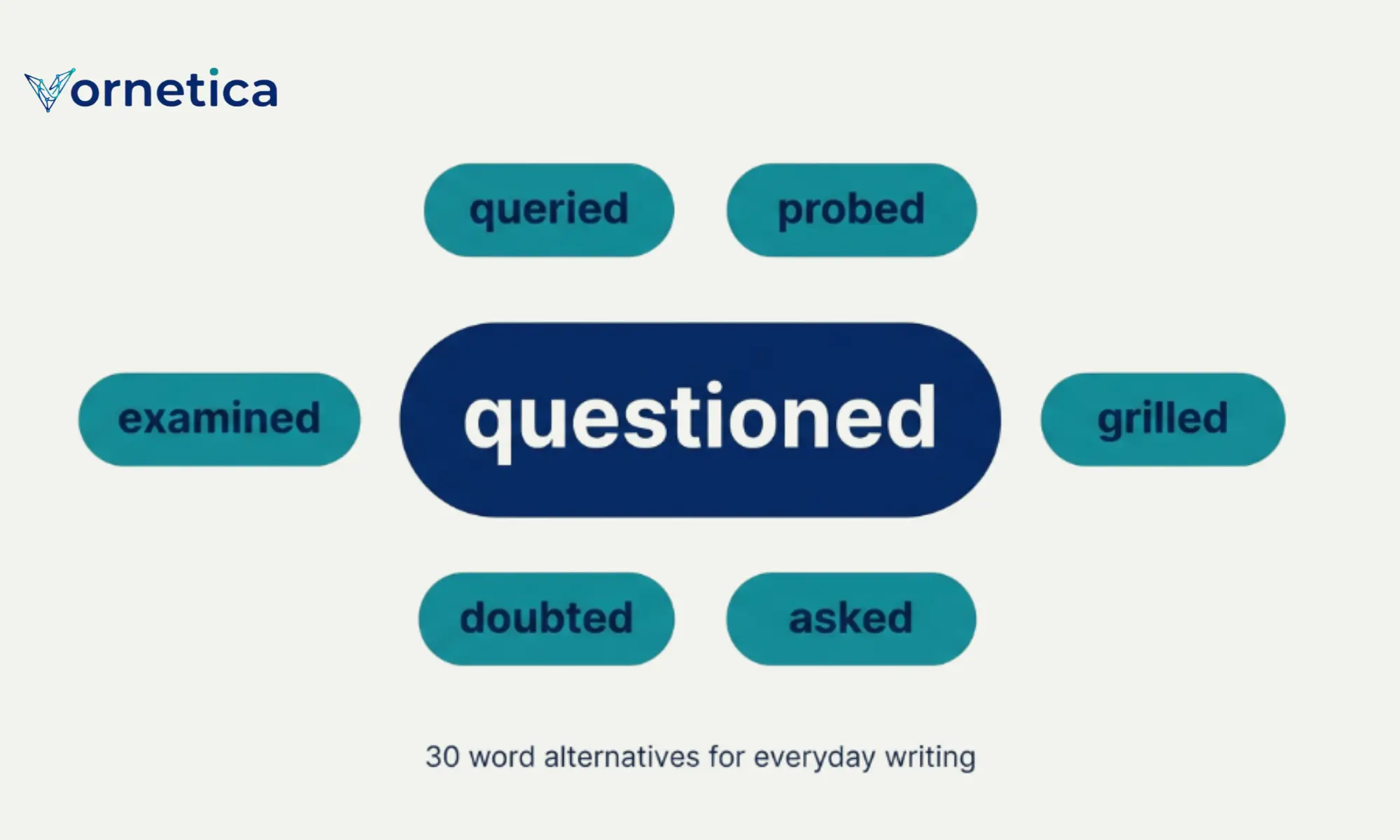
What is another word for questioned? Common alternatives include asked, inquired, challenged, interrogated, and doubted. The best synonym depends on whether you mean asking for information, investigating, or showing doubt.
Main Content – Synonyms List
1. Asked
Meaning: Asked means you wanted someone to give you information or an answer.
Examples:
- I asked Sara about her new job.
- He asked me where the station was.
Best Used When: Use it in everyday speech and simple writing.
2. Inquired
Meaning: Inquired means asked for information in a polite or formal way.
Examples:
- She inquired about the cost of the course.
- I inquired about the meeting time.
Best Used When: Use it in formal emails, letters, and professional writing.
3. Challenged
Meaning: Challenged means questioned something because you were not sure it was right.
Examples:
- The student challenged the teacher’s claim.
- She challenged his reason for leaving early.
Best Used When: Use it when someone questions an idea, claim, or decision.
4. Interrogated
Meaning: Interrogated means asked someone many questions to get information.
Examples:
- The police interrogated the suspect.
- The reporter was interrogated about the leaked story.
Best Used When: Use it for serious investigations or official questioning.
5. Doubted
Meaning: Doubted means you were not sure that something was true.
Examples:
- I doubted his story at first.
- She doubted that the plan would work.
Best Used When: Use it when showing disbelief or uncertainty.
6. Probed
Meaning: Probed means asked careful questions to learn more about something.
Examples:
- The journalist probed the minister about the decision.
- She probed for more details about the problem.
Best Used When: Use it for deep or careful questioning.
7. Queried
Meaning: Queried means asked someone for information or an explanation.
Examples:
- I queried the manager about the bill.
- She queried why the order was late.
Best Used When: Use it in formal, business, or technical writing.
8. Investigated
Meaning: Investigated means carefully looked for facts about a problem or event.
Examples:
- The team investigated the complaint.
- Police investigated the cause of the accident.
Best Used When: Use it for formal investigations and serious situations.
9. Examined
Meaning: Examined means carefully checked something to understand it.
Examples:
- The teacher examined his answer closely.
- The lawyer examined the evidence.
Best Used When: Use it in academic, legal, medical, or formal contexts.
10. Scrutinized
Meaning: Scrutinized means examined something very carefully.
Examples:
- The editor scrutinized every line of the report.
- The company scrutinized the new proposal.
Best Used When: Use it for careful review in formal writing.
11. Cross-examined
Meaning: Cross-examined means asked a witness detailed questions to test their answers.
Examples:
- The lawyer cross-examined the witness.
- She was cross-examined during the trial.
Best Used When: Use it mainly in legal contexts.
12. Consulted
Meaning: Consulted means asked someone for advice or information.
Examples:
- I consulted my teacher about the project.
- She consulted a lawyer before signing.
Best Used When: Use it when seeking expert advice or guidance.
13. Interviewed
Meaning: Interviewed means asked someone questions to get information from them.
Examples:
- The reporter interviewed the actor.
- We interviewed three candidates yesterday.
Best Used When: Use it for jobs, journalism, research, and surveys.
A good interview often includes questions that generate useful answers and details. If you are working on vocabulary about creating or producing something, you may also find this page useful: synonyms for generate.
14. Requested
Meaning: Requested means politely asked someone to do or provide something.
Examples:
- She requested more information about the course.
- I requested a copy of the report.
Best Used When: Use it in polite, formal, and professional communication.
15. Asked About
Meaning: Asked about means wanted information on a person, thing, or topic.
Examples:
- Mom asked about my new class.
- The manager asked about the missing file.
Best Used When: Use it in casual and everyday English.
16. Sought
Meaning: Sought means tried to get information, help, or an answer.
Examples:
- She sought advice from her mentor.
- We sought answers from the research team.
Best Used When: Use it in formal writing and academic English.
17. Demanded
Meaning: Demanded means asked strongly for an answer or explanation.
Examples:
- The customer demanded an explanation.
- She demanded to know the truth.
Best Used When: Use it when the person is angry, firm, or forceful.
18. Confronted
Meaning: Confronted means questioned someone directly about a problem or issue.
Examples:
- I confronted him about the missing money.
- She confronted her friend about the lie.
Best Used When: Use it for direct and sometimes tense conversations.
19. Accused
Meaning: Accused means said that someone may have done something wrong.
Examples:
- He accused me of breaking the vase.
- The worker was accused of stealing money.
Best Used When: Use it when questioning involves blame or wrongdoing.
20. Challenged the Truth
Meaning: Challenged the truth means said that something may not be true.
Examples:
- The lawyer challenged the truth of his statement.
- She challenged the truth of the report.
Best Used When: Use it in debates, arguments, legal writing, or critical discussions.
21. Disputed
Meaning: Disputed means said that something was not correct or true.
Examples:
- The company disputed the claim.
- He disputed the facts in the report.
Best Used When: Use it for formal disagreements about facts or claims.
22. Contested
Meaning: Contested means questioned or opposed something because you did not accept it.
Examples:
- The player contested the referee’s decision.
- She contested the result of the test.
Best Used When: Use it in legal, political, academic, or formal contexts.
23. Challenged the Validity
Meaning: Challenged the validity means questioned whether something was correct or acceptable.
Examples:
- The expert challenged the validity of the study.
- They challenged the validity of the contract.
Best Used When: Use it in academic, legal, and technical writing.
24. Questioned the Accuracy
Meaning: Questioned the accuracy means showed doubt about whether information was correct.
Examples:
- The editor questioned the accuracy of the report.
- She questioned the accuracy of the numbers.
Best Used When: Use it for reports, data, research, and professional writing.
When checking information, it is also useful to make sure a source can guarantee what it claims. For more vocabulary about certainty and promises, see synonyms for guarantee.
25. Challenged an Idea
Meaning: Challenged an idea means asked whether an idea was correct or useful.
Examples:
- The student challenged the idea in class.
- She challenged his idea during the meeting.
Best Used When: Use it in discussions, essays, debates, and presentations.
26. Asked for Clarification
Meaning: Asked for clarification means asked someone to explain something more clearly.
Examples:
- I asked for clarification about the instructions.
- She asked for clarification before starting the task.
Best Used When: Use it in school, work, emails, and professional conversations.
Clear questions often help people implement a plan correctly because everyone understands what needs to happen. You can explore more vocabulary related to putting plans into action here: synonyms for implement.
27. Requested an Explanation
Meaning: Requested an explanation means asked someone to explain why something happened.
Examples:
- The customer requested an explanation.
- She requested an explanation for the delay.
Best Used When: Use it in formal complaints, emails, and professional situations.
28. Pressed
Meaning: Pressed means continued asking questions to get a clear answer.
Examples:
- The reporter pressed him for details.
- I pressed her for a better answer.
Best Used When: Use it when someone keeps asking because the first answer is not enough.
29. Posed Questions
Meaning: Posed questions means presented questions for someone to think about or answer.
Examples:
- The teacher posed several questions to the class.
- The article posed questions about the future.
Best Used When: Use it in academic, professional, and creative writing.
30. Challenged a Claim
Meaning: Challenged a claim means questioned whether a statement was true.
Examples:
- The scientist challenged the claim.
- The writer challenged the claim with new evidence.
Best Used When: Use it in essays, research, journalism, and debates.
Comparison Table
| Synonym | Tone (Formal/Neutral/Casual) | Best Used In (writing/speech/technical) |
| Asked | Neutral | Writing / Speech |
| Inquired | Formal | Writing / Speech |
| Challenged | Neutral | Writing / Speech |
| Interrogated | Formal | Writing / Speech |
| Doubted | Neutral | Writing / Speech |
| Probed | Formal | Writing / Speech |
| Queried | Formal | Writing / Technical |
| Investigated | Formal | Writing / Technical |
| Examined | Formal | Writing / Technical |
| Scrutinized | Formal | Writing / Technical |
| Cross-examined | Formal | Writing / Legal |
| Consulted | Formal | Writing / Speech |
| Interviewed | Neutral | Writing / Speech |
| Requested | Formal | Writing / Speech |
| Asked About | Casual | Speech / Writing |
| Sought | Formal | Writing |
| Demanded | Neutral | Speech / Writing |
| Confronted | Neutral | Speech / Writing |
| Accused | Neutral | Speech / Writing |
| Challenged the Truth | Formal | Writing |
| Disputed | Formal | Writing / Technical |
| Contested | Formal | Writing / Legal |
| Challenged the Validity | Formal | Writing / Technical |
| Questioned the Accuracy | Formal | Writing / Technical |
| Challenged an Idea | Neutral | Writing / Speech |
| Asked for Clarification | Neutral | Writing / Speech |
| Requested an Explanation | Formal | Writing / Speech |
| Pressed | Neutral | Speech / Writing |
| Posed Questions | Formal | Writing / Speech |
| Challenged a Claim | Formal | Writing / Technical |
Frequently Asked Questions
1. What is another word for questioned?
Another word for questioned is asked, inquired, challenged, interrogated, or doubted. The best choice depends on the meaning.
2. What is a formal synonym for questioned?
Inquired or queried can be formal synonyms for questioned. Interrogated is also formal but suggests serious or detailed questioning.
3. What is a simple synonym for questioned?
Asked is the simplest and most common synonym for questioned. It works well in everyday English.
4. What is a synonym for questioned that shows doubt?
Doubted, challenged, disputed, and contested can show doubt. Choose the word that best matches the situation.
5. What is the difference between asked and interrogated?
Asked is general and can be friendly or neutral. Interrogated suggests asking many serious questions, often during an investigation.
Practice Exercise
Fill in each blank with the best synonym from the list.
- The teacher ________ me about my missing homework.
- The lawyer ________ the witness during the trial.
- She ________ about the price before buying the phone.
- The scientist ________ the accuracy of the old data.
- The police ________ the suspect for several hours.
Answer Key
- asked
- cross-examined
- inquired
- questioned
- interrogated
Key Takeaways
- Asked is the easiest and most common synonym for questioned.
- Inquired works well in polite and formal situations.
- Interrogated suggests serious and detailed questioning.
- Challenged and disputed are useful when you doubt an idea or claim.
- Probed suggests careful questions used to find deeper information.
- Choose your synonym based on the tone and situation, not just the basic meaning.
Good writing also depends on choosing words that fit the action clearly. For example, something may be made, created, or produced, depending on the sentence. If you want more vocabulary choices for “made,” you can read synonyms for made.
In professional settings, choosing the right word can make your message easier to understand. When you talk about handling questions, tasks, or problems, knowing how to manage them is also useful. Explore more alternatives on synonyms for manage.
Conclusion
Learning synonyms for questioned gives you more ways to express ideas clearly.
Words like asked, inquired, challenged, probed, and interrogated can make your writing and speech more precise.
These words are useful in emails, essays, blogs, reports, and daily conversations. Practice one new synonym at a time and notice how its meaning changes with the situation.
When you want to improve another part of your vocabulary, search for another word on the site and keep learning.