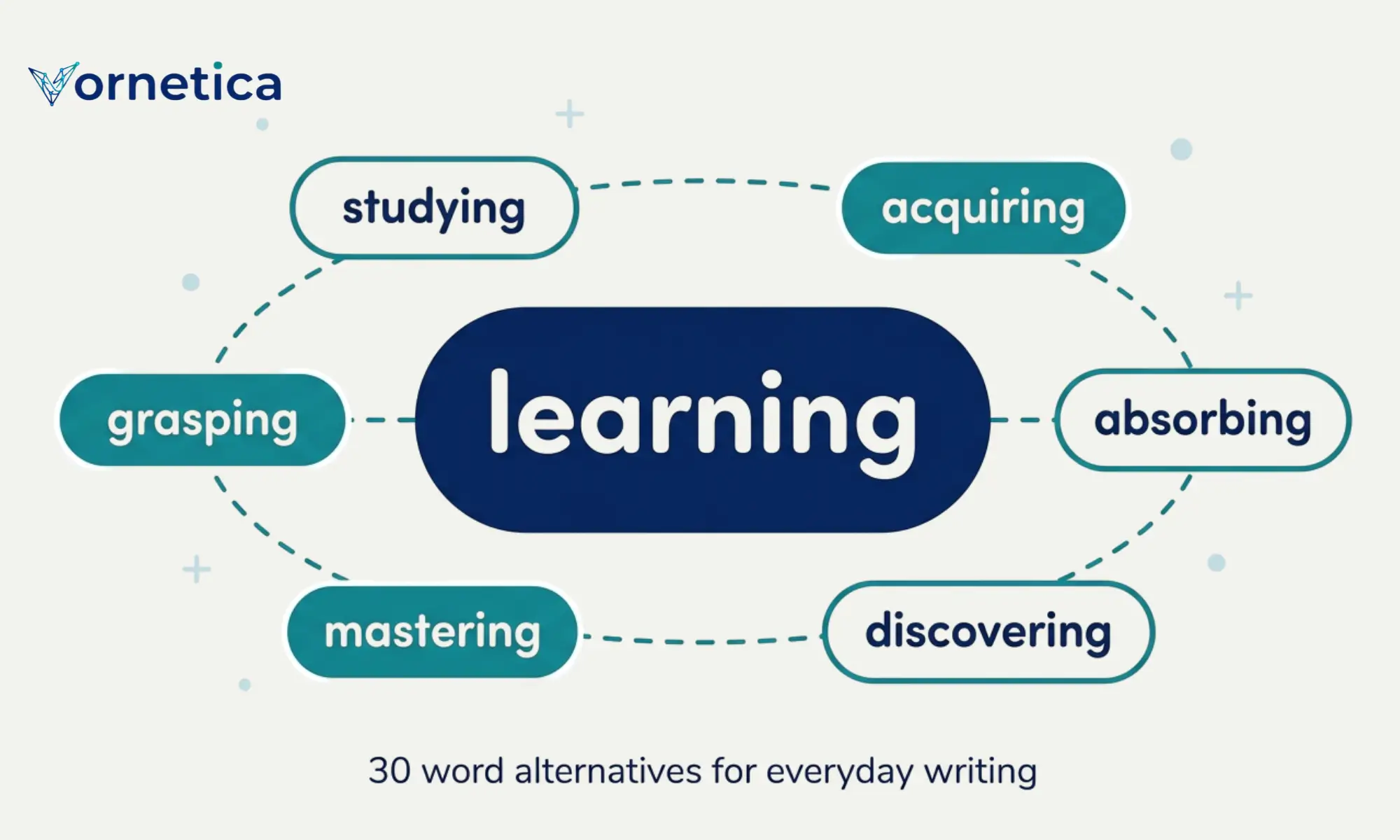
Have you ever used the word “learning” again and again in your school essay?
Your writing may sound boring when you use the same word too often. A few simple alternatives can make your sentences more interesting.
For example, you can say, “Learning English takes time.” You can also say, “Studying English takes time.” Both sentences share a similar idea, but each uses a different word.
Synonyms for learning are words that have the same or a close meaning as learning.
Some words describe gaining facts, while others describe building skills or finding new ideas.
Students can use these words in homework and essays. Bloggers and content writers can make their posts more engaging.
Daily English users can also speak and write with more confidence.
Quick Answer Box
What is another word for learning? Common synonyms include education, study, knowledge, training, and discovery. Choose the word that best matches your meaning and sentence.
Top 5 synonyms: Education, study, knowledge, training, discovery.
30 Synonyms for Learning
1. Education
Meaning: Education is the process of gaining knowledge and skills.
Examples:
- Education helps children build a better future.
- My sister wants a good education.
Best Used When: Talking about schools, colleges, and formal learning.
2. Study
Meaning: Study means spending time learning about a subject.
Examples:
- I study English every morning.
- Ali needs to study for his science test.
Best Used When: Talking about schoolwork, exams, or personal learning.
3. Knowledge
Meaning: Knowledge is the information and facts that you know.
Examples:
- Books give us knowledge about many things.
- Her knowledge of animals helped the class.
Best Used When: Describing facts and information someone has gained.
4. Training
Meaning: Training is learning how to do a task or skill.
Examples:
- The new workers received computer training.
- I need more training to become a better cook.
Best Used When: Talking about jobs, sports, and practical skills.
5. Discovery
Meaning: Discovery is finding something new or learning something you did not know.
Examples:
- The discovery of a new planet excited the students.
- Reading that book was a wonderful discovery.
Best Used When: Describing new findings, ideas, or exciting learning moments.
6. Instruction
Meaning: Instruction is guidance that tells someone how to do something.
Examples:
- The teacher gave clear instructions.
- I followed the instructions to build the toy.
Best Used When: Talking about lessons, directions, or guided learning.
7. Teaching
Meaning: Teaching is helping another person learn something.
Examples:
- Teaching young children takes patience.
- My teacher’s teaching helped me understand math.
Best Used When: Describing how someone shares knowledge with others.
8. Practice
Meaning: Practice means doing something again and again to improve.
Examples:
- Daily practice helps me speak English.
- With practice, she learned to play the guitar.
Best Used When: Talking about improving skills through repeated effort.
9. Understanding
Meaning: Understanding means knowing what something means or how it works.
Examples:
- I have a better understanding of this lesson.
- His understanding of the rules improved.
Best Used When: Explaining how well someone grasps an idea or subject.
10. Awareness
Meaning: Awareness means knowing that something exists or is happening.
Examples:
- The school raised awareness about road safety.
- Reading the news increased my awareness of world events.
Best Used When: Discussing social issues, risks, events, and public knowledge.
When you write about people moving to a new country, you can explore synonyms for immigration to find words that fit your topic.
11. Insight
Meaning: Insight is a clear and deep understanding of something.
Examples:
- Her story gave me insight into village life.
- The lesson offered insight into human behavior.
Best Used When: Writing thoughtful essays, reports, or discussions.
12. Exploration
Meaning: Exploration is learning about a place, subject, or idea by looking into it.
Examples:
- Space exploration teaches us about the universe.
- Our class began an exploration of local history.
Best Used When: Talking about research, new places, and ideas.
For example, students exploring rocks, soil, and the Earth’s surface can read synonyms for geology to build their topic-related vocabulary.
13. Research
Meaning: Research is the careful study of a topic to find facts.
Examples:
- I did research before writing my school project.
- Her research helped the team find an answer.
Best Used When: Writing academic papers, reports, or fact-based blog posts.
14. Investigation
Meaning: Investigation means looking closely at something to find out what happened.
Examples:
- The students started an investigation into water waste.
- Our investigation showed why the machine had stopped.
Best Used When: Describing problem-solving, fact-finding, or careful study.
When writing about a computer problem, you might also need the word glitch. Read synonyms for glitch to find suitable words for a small error or fault.
15. Guidance
Meaning: Guidance is help that shows someone what to do or how to learn.
Examples:
- My teacher gave me guidance with my homework.
- Good guidance helped us finish the project.
Best Used When: Talking about support from teachers, parents, or coaches.
16. Familiarization
Meaning: Familiarization is the process of getting to know something new.
Examples:
- The first day was for familiarization with the new school.
- We had a short familiarization session before using the machine.
Best Used When: Describing how people get used to new tools, places, or tasks.
17. Enlightenment
Meaning: Enlightenment is gaining a clearer or deeper understanding.
Examples:
- The talk gave me new ideas and enlightenment.
- Her journey brought enlightenment about what mattered most.
Best Used When: Writing about deep ideas, personal growth, or new ways of thinking.
18. Development
Meaning: Development is the process of growing or improving skills and knowledge.
Examples:
- Reading supports the development of language skills.
- The course helped with my professional development.
Best Used When: Discussing progress in education, work, or personal skills.
19. Growth
Meaning: Growth is the process of becoming better or knowing more.
Examples:
- Every mistake can lead to growth.
- Reading helped her grow as a writer.
Best Used When: Talking about personal improvement and long-term progress.
20. Mastery
Meaning: Mastery means having a very high level of skill or knowledge.
Examples:
- He worked hard to gain mastery of the piano.
- Mastery of grammar improved her writing.
Best Used When: Describing a strong level of skill in a subject or activity.
21. Acquisition
Meaning: Acquisition is the process of gaining knowledge or skills.
Examples:
- Language acquisition takes time and practice.
- The course supports the acquisition of useful skills.
Best Used When: Using a formal or technical tone in education and research.
22. Comprehension
Meaning: Comprehension is the ability to understand what you read or hear.
Examples:
- The teacher gave us a reading comprehension test.
- Good comprehension helps students follow a story.
Best Used When: Talking about reading, listening, and understanding lessons.
23. Absorption
Meaning: Absorption is the process of taking in information or ideas.
Examples:
- Quiet reading helped with the absorption of new facts.
- The lesson allowed the absorption of useful ideas.
Best Used When: Describing how people take in information, especially in formal writing.
24. Perception
Meaning: Perception is the way someone sees or understands something.
Examples:
- The lesson changed my perception of teamwork.
- Travel can shape our perception of other cultures.
Best Used When: Discussing opinions, views, or changes in the way people think.
25. Realization
Meaning: Realization is the moment when you understand something clearly.
Examples:
- I had a realization while reading the final chapter.
- Her realization helped her solve the problem.
Best Used When: Describing a sudden understanding or an important personal lesson.
26. Reflection
Meaning: Reflection is careful thought about an event, idea, or experience.
Examples:
- Reflection helped me learn from my mistake.
- She wrote a reflection after the school trip.
Best Used When: Writing journals, personal essays, or learning reviews.
Reflection can also help people think about fairness and how others are treated. For related vocabulary, see synonyms for injustice.
27. Observation
Meaning: Observation is watching something carefully to learn about it.
Examples:
- The children learned about plants through observation.
- Careful observation helped us spot the small change.
Best Used When: Describing science lessons, experiments, and learning from real life.
28. Experimentation
Meaning: Experimentation is trying different things to see what works.
Examples:
- Experimentation helped the team find a better method.
- The students used experimentation to test their ideas.
Best Used When: Talking about science, creative work, or testing new methods.
29. Coaching
Meaning: Coaching is helping someone improve through advice, practice, and support.
Examples:
- Coaching helped me feel ready for the match.
- She improved her speaking skills through coaching.
Best Used When: Discussing personal guidance, sports, or workplace skills.
30. Self-Education
Meaning: Self-education is learning something on your own without a formal teacher.
Examples:
- Online videos helped him with self-education.
- She used books for self-education after work.
Best Used When: Talking about independent study and learning outside school.
How to Choose the Right Synonym for Learning
Not every synonym works in every sentence. Some words describe gaining facts, while others focus on practice, discovery, or deep understanding.
Use these simple tips to choose the right word:
- Use education when talking about school or formal study.
- Use practice when someone repeats an action to improve.
- Use knowledge when talking about facts a person knows.
- Use research when someone studies a topic to find answers.
- Use discovery when someone finds something new.
- Use mastery when someone has reached a high skill level.
- Use reflection when someone thinks about an experience to learn from it.
For example, “I am learning to cook” can become “I am practicing how to cook.” However, “I gained knowledge about cooking” focuses more on the information you learned.
Choose words based on the meaning you want to share. A good synonym should make your sentence clearer, not harder to understand.
Comparison Table: Synonyms for Learning
| Synonym | Tone | Best Used In |
| Education | Formal | Writing, speech |
| Study | Neutral | Writing, speech |
| Knowledge | Neutral | Writing, speech |
| Training | Neutral | Speech, technical |
| Discovery | Neutral | Writing, speech |
| Instruction | Formal | Writing, technical |
| Teaching | Neutral | Writing, speech |
| Practice | Neutral | Writing, speech |
| Understanding | Neutral | Writing, speech |
| Awareness | Formal | Writing, speech |
| Insight | Formal | Writing, speech |
| Exploration | Neutral | Writing, technical |
| Research | Formal | Writing, technical |
| Investigation | Formal | Writing, technical |
| Guidance | Neutral | Writing, speech |
| Familiarization | Formal | Writing, technical |
| Enlightenment | Formal | Writing, creative |
| Development | Neutral | Writing, technical |
| Growth | Neutral | Writing, speech |
| Mastery | Formal | Writing, technical |
| Acquisition | Formal | Writing, technical |
| Comprehension | Formal | Writing, technical |
| Absorption | Formal | Writing, technical |
| Perception | Formal | Writing, speech |
| Realization | Neutral | Writing, speech |
| Reflection | Neutral | Writing, creative |
| Observation | Neutral | Writing, technical |
| Experimentation | Formal | Writing, technical |
| Coaching | Neutral | Speech, technical |
| Self-education | Neutral | Writing, speech |
Frequently Asked Questions
1. What is another word for learning?
Education, study, training, and knowledge are common alternatives. Choose the word that best fits your sentence.
2. What are the five best synonyms for learning?
Five useful synonyms are education, study, knowledge, training, and discovery. They work well in many everyday situations.
3. What is a formal word for learning?
Acquisition is a formal word for gaining knowledge or skills. It is often used in education and research.
4. What is the difference between learning and knowledge?
Learning is the process of gaining new information or skills. Knowledge is what you know after learning.
5. How can I use learning synonyms in a sentence?
Replace learning with a word that fits your meaning. For example, “Learning a language takes time” can become “Language study takes time.”
Practice Exercise
Fill in each blank with the best synonym from the list above.
- Daily ______ helps me become a better guitar player.
- The school gives children a good ______.
- The scientist did ______ to find the answer.
- Reading books helps us gain ______.
- She reached ______ of the new skill after years of work.
Answer Key
- Practice
- Education
- Research
- Knowledge
- Mastery
Key Takeaways
- Education is best for school and formal learning.
- Study works well for lessons, exams, and personal learning.
- Knowledge means the facts and information you know.
- Training helps people build practical skills.
- Discovery describes finding something new.
- Tip: Learn one new synonym each day and use it in your own sentence.
Conclusion
Learning synonyms helps you write better essays, create stronger blog posts, and speak with more confidence.
Words like education, practice, knowledge, and discovery can make your sentences clearer and more interesting.
Try using these words in your emails, essays, and daily conversations. Start with one new synonym each day and practice it in a sentence.
Keep building your vocabulary, and search for another word on the site whenever you want to improve your English.