Have you ever written the word “facts” several times in the same paragraph? It can make your writing sound plain and repetitive.
For example, you may write, “The facts show that the plan worked.” A few lines later, you may want to say the same thing again.
That is where synonyms for facts can help. Facts are things that are true and can be checked or proven.
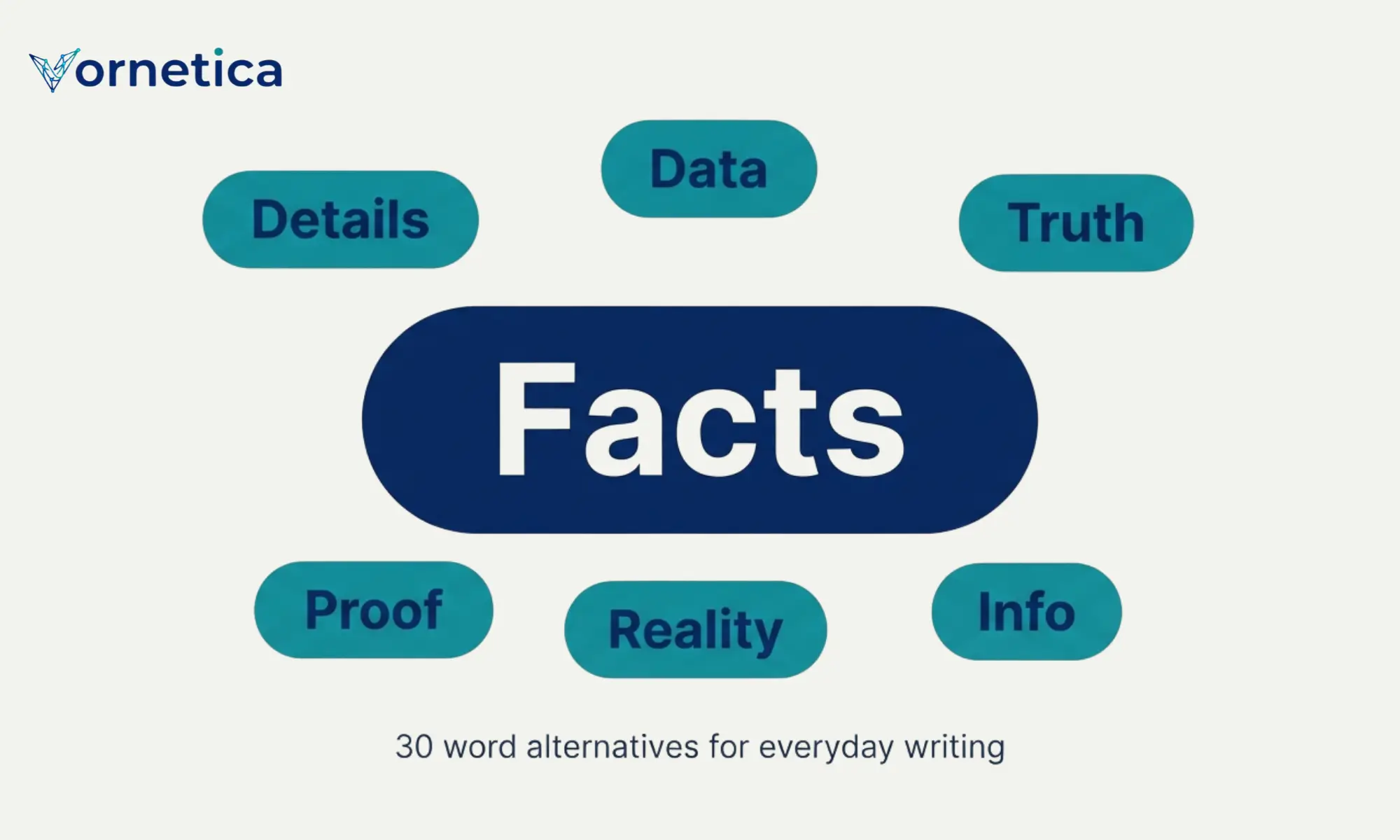
Words such as truths, details, data, evidence, information, and findings can often replace “facts,” depending on the sentence.
Learning synonyms for facts helps students write better essays. Bloggers can make their posts more interesting.
Content writers can avoid repeating the same word. Daily English users can also speak and write with more confidence.
The right synonym makes your meaning clearer and helps your words fit the situation.
Quick Answer Box
What is another word for facts? Common alternatives include truths, details, information, data, and evidence. The best synonym depends on whether you are talking about true statements, numbers, proof, or specific information.
Main Content – 30 Synonyms for Facts
1. Truths
Meaning: Truths are things that are true and not false.
Examples:
- We should always tell the truths we know.
- The book explains some important truths about history.
Best Used When: Use it for general or personal statements that are known to be true.
2. Realities
Meaning: Realities are things that truly exist or happen.
Examples:
- We must accept the realities of the situation.
- The report shows the realities of life in the area.
Best Used When: Use it when discussing real conditions or situations.
3. Details
Meaning: Details are small pieces of information about something.
Examples:
- Please check the details before signing the form.
- She gave me all the details about the trip.
Best Used When: Use it for specific pieces of information.
4. Data
Meaning: Data is information collected for study or use.
Examples:
- The scientist studied the data carefully.
- The data shows how many people visited the site.
Best Used When: Use it in research, business, science, and technical writing.
5. Information
Meaning: Information is knowledge or facts about something.
Examples:
- I need more information before I decide.
- The website gives useful information about the course.
Best Used When: Use it as a broad and neutral replacement for facts.
6. Figures
Meaning: Figures are numbers or amounts that give useful information.
Examples:
- The sales figures were higher this month.
- Check the figures before sending the report.
Best Used When: Use it for numbers, statistics, money, or business results.
For more vocabulary related to different situations and relationships, you can also explore synonyms for dynamics.
7. Findings
Meaning: Findings are facts discovered through research or study.
Examples:
- The study published its findings last week.
- Her findings surprised the whole team.
Best Used When: Use it for research, surveys, studies, and investigations.
8. Evidence
Meaning: Evidence is information that helps show that something is true.
Examples:
- The police found evidence at the scene.
- There is strong evidence that the plan worked.
Best Used When: Use it when facts support a claim or prove something.
9. Proof
Meaning: Proof is clear evidence that shows something is true.
Examples:
- Do you have proof of your payment?
- The photo was proof that he was there.
Best Used When: Use it when you need strong support for a claim.
10. Records
Meaning: Records are written or stored information about something.
Examples:
- The school keeps records of every student.
- We checked the old records for the answer.
Best Used When: Use it for official documents, history, accounts, or stored information.
11. Particulars
Meaning: Particulars are exact details about something.
Examples:
- Please send me the particulars of the meeting.
- The contract includes all the important particulars.
Best Used When: Use it in formal writing, business, and official communication.
12. Points
Meaning: Points are specific ideas or facts that someone mentions.
Examples:
- She made several good points during the meeting.
- Write down the main points from the lesson.
Best Used When: Use it for short facts or ideas in speech and writing.
13. Observations
Meaning: Observations are things noticed through careful watching or study.
Examples:
- His observations helped the team find the problem.
- The teacher wrote down her observations.
Best Used When: Use it for research, science, teaching, or careful study.
14. Statements
Meaning: Statements are things that someone says or writes as true.
Examples:
- The witness gave a clear statement.
- His statement matched the available evidence.
Best Used When: Use it for spoken, written, official, or public claims.
15. Accounts
Meaning: Accounts are descriptions of events or experiences.
Examples:
- Several people gave accounts of the accident.
- Her account of the trip was very detailed.
Best Used When: Use it for descriptions of events, especially from someone’s point of view.
16. Reports
Meaning: Reports are written or spoken descriptions of information or events.
Examples:
- The company released its annual report.
- News reports confirmed the storm damage.
Best Used When: Use it for formal information shared by an organization, person, or news source.
17. Statistics
Meaning: Statistics are numbers that show facts about a group or situation.
Examples:
- The statistics show a rise in online shopping.
- We used statistics to support our argument.
Best Used When: Use it for numbers, surveys, research, and measurable results.
Good writing also depends on choosing words that show action and progress. If you are building vocabulary around that idea, see synonyms for effort.
18. Circumstances
Meaning: Circumstances are the conditions around an event or situation.
Examples:
- We need to understand the circumstances first.
- The police looked at the circumstances of the case.
Best Used When: Use it when facts describe the conditions around an event.
19. Conditions
Meaning: Conditions are the situations or factors that affect something.
Examples:
- The weather conditions were dangerous.
- The report explains the working conditions.
Best Used When: Use it for situations, environments, rules, or physical states.
20. Events
Meaning: Events are things that happen at a particular time or place.
Examples:
- The newspaper listed the main events of the day.
- We discussed the events that led to the change.
Best Used When: Use it when facts describe things that happened.
21. Occurrences
Meaning: Occurrences are events or things that happen.
Examples:
- Such occurrences are rare in this area.
- The report lists unusual occurrences from the past year.
Best Used When: Use it in formal or technical writing about events.
22. Instances
Meaning: Instances are particular examples of something happening.
Examples:
- There were several instances of late payment.
- The teacher gave two instances to explain the rule.
Best Used When: Use it when talking about specific examples or cases.
23. Matters
Meaning: Matters are subjects, issues, or things being discussed.
Examples:
- We need to discuss the important matters today.
- The facts changed how we viewed the matter.
Best Used When: Use it for topics, issues, or situations in formal and neutral writing.
24. Cases
Meaning: Cases are particular situations or examples.
Examples:
- There are many cases of this problem.
- The lawyer studied several cases before the trial.
Best Used When: Use it for law, medicine, examples, and specific situations.
25. Certainties
Meaning: Certainties are things that are definitely true or sure.
Examples:
- We have few certainties about the future.
- Her answer was based on certainties, not guesses.
Best Used When: Use it when you want to stress that something is definitely true.
26. Verities
Meaning: Verities are truths that are accepted as real or true.
Examples:
- The book discusses some basic human verities.
- He believed in the simple verities of life.
Best Used When: Use it in formal, literary, or philosophical writing.
27. Specifics
Meaning: Specifics are exact details about something.
Examples:
- Can you give me the specifics of the plan?
- We need the specifics before we begin.
Best Used When: Use it when you want exact and clear details.
For articles that help build a wider vocabulary around positive communication, you can read synonyms for encouragement.
28. Declarations
Meaning: Declarations are clear statements made publicly or officially.
Examples:
- The company made a declaration about the new policy.
- His declaration was recorded by the officials.
Best Used When: Use it for official, public, or formal statements.
29. Disclosures
Meaning: Disclosures are facts or information that are made known.
Examples:
- The report included important financial disclosures.
- The company made several disclosures to investors.
Best Used When: Use it for business, legal, financial, or official information.
30. Actualities
Meaning: Actualities are real facts or conditions rather than ideas or guesses.
Examples:
- The report focuses on the actualities of the situation.
- We need to understand the actualities before making a plan.
Best Used When: Use it in formal or academic writing when stressing real conditions.
Comparison Table
| Synonym | Tone (Formal/Neutral/Casual) | Best Used In (writing/speech/technical) |
| Truths | Neutral | Writing/Speech |
| Realities | Neutral | Writing/Speech |
| Details | Neutral | Writing/Speech |
| Data | Formal | Technical/Writing |
| Information | Neutral | Writing/Speech |
| Figures | Neutral | Business/Writing |
| Findings | Formal | Technical/Writing |
| Evidence | Formal | Writing/Speech |
| Proof | Neutral | Writing/Speech |
| Records | Formal | Writing/Technical |
| Particulars | Formal | Writing |
| Points | Neutral | Writing/Speech |
| Observations | Formal | Technical/Writing |
| Statements | Neutral | Writing/Speech |
| Accounts | Neutral | Writing/Speech |
| Reports | Formal | Writing/Technical |
| Statistics | Formal | Technical/Writing |
| Circumstances | Formal | Writing/Speech |
| Conditions | Neutral | Writing/Technical |
| Events | Neutral | Writing/Speech |
| Occurrences | Formal | Technical/Writing |
| Instances | Formal | Writing |
| Matters | Formal | Writing/Speech |
| Cases | Neutral | Writing/Speech |
| Certainties | Formal | Writing |
| Verities | Formal | Creative/Writing |
| Specifics | Neutral | Writing/Speech |
| Declarations | Formal | Writing |
| Disclosures | Formal | Technical/Writing |
| Actualities | Formal | Academic/Writing |
Frequently Asked Questions
What is another word for facts?
Common synonyms include truths, information, details, data, evidence, and findings. The best choice depends on the context.
What is a formal word for facts?
Findings, evidence, particulars, statistics, records, and verities can sound more formal than the simple word “facts.”
What is a synonym for facts and information?
Details, data, records, findings, and particulars can describe facts or information, depending on the sentence.
What is another word for facts in an essay?
Evidence, findings, information, statistics, and details work well in essays. Choose the word that matches your meaning.
What is the difference between facts and evidence?
A fact is something that is true. Evidence is information that helps prove that something is true.
Practice Exercise
Fill in each blank with the best synonym from the list above.
- The scientist studied the ________ from the experiment before writing the report.
- Please give me the ________ of the meeting, including the time and location.
- The photograph was clear ________ that the person was there.
- The teacher shared her ________ after watching the students work.
- The company released new sales ________ at the end of the month.
Answer Key
- data
- particulars
- proof
- observations
- figures
Key Takeaways
- Truths are good for things that are simply true.
- Details work well for small or exact pieces of information.
- Data is useful for research, science, and numbers.
- Evidence helps support or prove a claim.
- Findings are best for results from research or study.
- Tip: Always choose a synonym based on the meaning and situation, not just because it sounds different.
When choosing vocabulary, context matters more than simply replacing one word with another. A synonym should keep the original meaning clear.
If you enjoy learning useful vocabulary for reading, writing, and everyday communication, you may also find synonyms for entertainment helpful for expanding your word choices.
You can also explore vocabulary related to different periods and historical writing with synonyms for era.
Conclusion
Learning synonyms for facts can make your writing clearer and less repetitive. Words such as truths, details, data, evidence, findings, and information each have a slightly different use.
This helps students write stronger essays, bloggers create better content, and daily English users communicate with more confidence.
Practice these words in emails, essays, reports, and daily conversations. Once you learn how each word works, you can choose the right one more naturally.
Keep building your vocabulary by searching for another word on the site.