Imagine a teacher checking the class list before a lesson starts.
Some students are in their seats, while others are missing. The teacher is checking their attendance. Attendance simply means being present at a place, event, class, or meeting.
Knowing different synonyms for attendance can help you avoid using the same word again and again.
Students can use these words in essays and school work. Bloggers and content writers can use them to make their writing more natural.
Daily English users can also use them in emails, meetings, and conversations.
For example, you might say, “Her attendance at the meeting was important.” You could also say, “Her presence at the meeting was important.”
Learning synonyms for attendance helps you choose the word that fits your exact situation.
QUICK ANSWER BOX
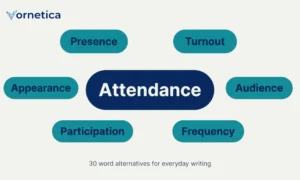
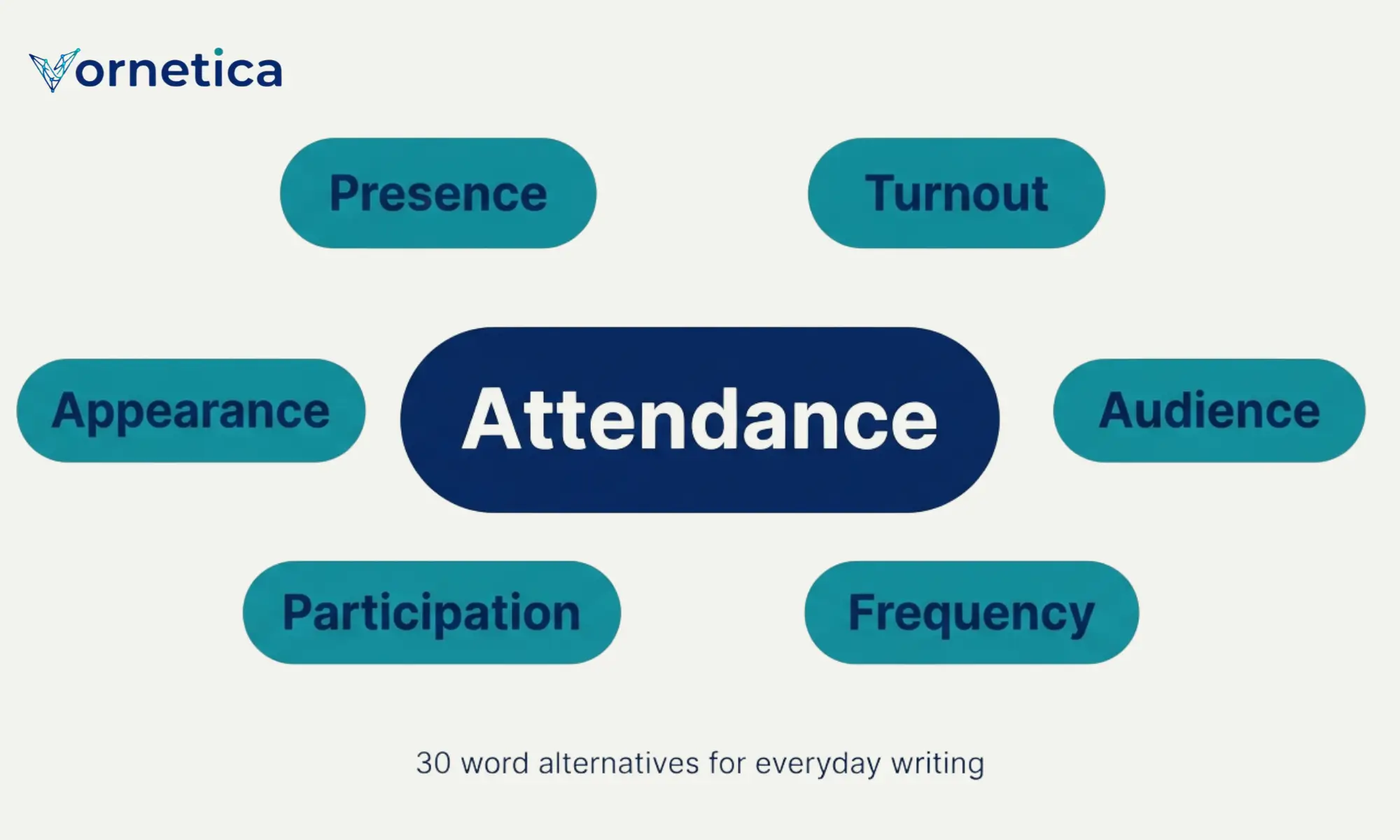
What is another word for attendance? Another word for attendance is presence, especially when talking about being present somewhere. Other common synonyms include participation, turnout, appearance, and showing.
1. Presence
Meaning: Presence means being in a place or at an event.
Examples:
- Her presence made the meeting more useful.
- The teacher noticed his presence in class.
Best Used When: Use it for formal and everyday situations when someone is physically present.
2. Participation
Meaning: Participation means taking part in an activity or event.
Examples:
- Her participation in class was excellent.
- We need more participation from the students.
Best Used When: Use it when attendance also includes active involvement.
3. Turnout
Meaning: Turnout means the number of people who come to an event.
Examples:
- The school concert had a large turnout.
- We were happy with the turnout at the meeting.
Best Used When: Use it for events, meetings, elections, and public gatherings.
4. Appearance
Meaning: Appearance means coming to a place or event.
Examples:
- His appearance at the event surprised us.
- She made an appearance at the school fair.
Best Used When: Use it when someone comes to an event, especially for a short time.
5. Showing
Meaning: Showing means coming to a place or event.
Examples:
- Thanks for showing at the party.
- His showing at the meeting was appreciated.
Best Used When: Use it in casual or conversational English.
6. Attendance Rate
Meaning: Attendance rate means the percentage of times someone is present.
Examples:
- Her attendance rate is above 95 percent.
- The school tracks each student’s attendance rate.
Best Used When: Use it in schools, workplaces, reports, and statistics.
7. Check-In
Meaning: Check-in means recording that you have arrived.
Examples:
- Please complete your check-in before the class.
- My check-in was recorded at the front desk.
Best Used When: Use it for events, hotels, workplaces, classes, and digital systems.
8. Enrollment
Meaning: Enrollment means being officially registered for a class or program.
Examples:
- Student enrollment increased this year.
- Her enrollment in the course was confirmed.
Best Used When: Use it in education when talking about registered students, not daily presence.
9. Audience
Meaning: Audience means the people who are present to watch or listen.
Examples:
- The audience filled the small theater.
- A large audience attended the show.
Best Used When: Use it for concerts, speeches, shows, talks, and presentations.
10. Gathering
Meaning: Gathering means a group of people coming together.
Examples:
- A large gathering took place at the park.
- The family gathering lasted all evening.
Best Used When: Use it for social, family, community, and informal events.
11. Assembly
Meaning: Assembly means a group of people gathered in one place.
Examples:
- The students joined the morning assembly.
- The assembly began at nine o’clock.
Best Used When: Use it in schools, meetings, and formal group events.
12. Congregation
Meaning: Congregation means a group of people gathered for a religious service.
Examples:
- The congregation listened quietly.
- The congregation filled the church.
Best Used When: Use it mainly for religious settings.
13. Crowd
Meaning: Crowd means a large group of people in one place.
Examples:
- A huge crowd watched the game.
- The crowd grew after sunset.
Best Used When: Use it for busy public places, sports, concerts, and events.
14. House
Meaning: House can mean the number of people present at a show or theater.
Examples:
- The theater had a full house.
- We were happy to see a large house tonight.
Best Used When: Use it mainly in theater and entertainment contexts.
15. Visitation
Meaning: Visitation means the act or number of people visiting a place.
Examples:
- Museum visitation increased during summer.
- The park had high visitation last weekend.
Best Used When: Use it in formal, tourism, business, and statistical writing.
16. Patronage
Meaning: Patronage means support given by customers or visitors.
Examples:
- The cafe depends on regular patronage.
- The museum received strong public patronage.
Best Used When: Use it in business or formal writing about customers and visitors.
17. Engagement
Meaning: Engagement means taking part in or showing interest in something.
Examples:
- Student engagement improved this term.
- The event created strong audience engagement.
Best Used When: Use it when attendance includes interest or active involvement.
18. Involvement
Meaning: Involvement means taking part in something.
Examples:
- Her involvement in the project was helpful.
- We value student involvement in school events.
Best Used When: Use it when being present also means taking an active role.
19. Observance
Meaning: Observance means being present for or taking part in a special event or tradition.
Examples:
- The town held a ceremony for the observance.
- Many people joined the holiday observance.
Best Used When: Use it for holidays, traditions, ceremonies, and special occasions.
20. Arrival
Meaning: Arrival means coming to a place.
Examples:
- Please report your arrival at the front desk.
- Her arrival was recorded at 8:30 a.m.
Best Used When: Use it when focusing on the time or act of reaching a place.
21. Coming
Meaning: Coming means moving toward or arriving at a place or event.
Examples:
- Thanks for coming to the meeting.
- His coming to the event made us happy.
Best Used When: Use it in simple and casual English.
22. Visiting
Meaning: Visiting means going to a place or person for a short time.
Examples:
- Visiting the museum is popular in summer.
- We had many visitors visiting the center.
Best Used When: Use it for homes, museums, tourist sites, and other places people visit.
23. Representation
Meaning: Representation means someone being present on behalf of another person or group.
Examples:
- The company had strong representation at the event.
- Our school sent student representation to the meeting.
Best Used When: Use it in formal meetings, business, and organizational settings.
24. Delegation
Meaning: Delegation means a group sent to represent another group.
Examples:
- A business delegation attended the conference.
- The delegation arrived early for the meeting.
Best Used When: Use it for official, business, political, or organizational events.
25. Coverage
Meaning: Coverage can mean the people or groups represented at an event.
Examples:
- The conference had good international coverage.
- The event received wide media coverage.
Best Used When: Use it in media, events, and formal reports.
26. Occupancy
Meaning: Occupancy means the number of people using or filling a place.
Examples:
- The hotel had high occupancy.
- The hall reached full occupancy during the event.
Best Used When: Use it for hotels, rooms, buildings, and spaces.
27. Visitation Rate
Meaning: Visitation rate means how often people visit a place during a period.
Examples:
- The park’s visitation rate increased in July.
- The museum reported a higher visitation rate.
Best Used When: Use it in statistics, reports, tourism, and business writing.
28. Headcount
Meaning: Headcount means the number of people present.
Examples:
- The manager checked the headcount before lunch.
- We need a final headcount for the event.
Best Used When: Use it in workplaces, events, meetings, and casual business speech.
29. Register
Meaning: Register can mean an official record of people who are present.
Examples:
- Please sign the attendance register.
- The teacher checked the register before class.
Best Used When: Use it in schools, offices, meetings, and formal records.
30. Roll Call
Meaning: Roll call is the process of checking who is present.
Examples:
- The teacher took roll call at nine.
- We waited for roll call before starting the trip.
Best Used When: Use it in schools, military settings, meetings, and organized groups.
Natural Ways to Use Attendance Synonyms
The right synonym depends on what you want to say. Presence is a good choice when you simply mean that someone is there. For example, “Her presence at the meeting was helpful.”
Participation is different because it suggests that the person took part. A student can have good attendance but poor participation if they come to class but do not join activities.
Turnout is useful when you want to talk about the number of people who came to an event. You might say, “The event had a strong turnout.”
This is similar to choosing the right word when you study synonyms for win. Different words may have close meanings, but their natural use can change with the situation.
For formal writing, words such as attendance rate, visitation, occupancy, and representation can be useful. For simple daily English, presence, coming, showing, and headcount may sound more natural.
Attendance in Schools and Workplaces
Attendance is common in schools. Teachers use an attendance register to record which students are present. Schools may also calculate an attendance rate for each student.
At work, attendance can show whether employees arrive as expected. A company may use a check-in system or headcount during meetings and events.
If you are writing a report, choose the word carefully. “Attendance increased” is broad. “Turnout increased” focuses on the number of people who came. “Participation increased” focuses on active involvement.
This small difference can make your writing clearer. It is also useful to learn related vocabulary for communication, such as synonyms for yapping, when you want to describe how much someone talks.
Attendance at Events
Events often use several words related to attendance. A concert may have a large audience. A public meeting may have a strong turnout. A theater may have a full house.
A conference may talk about delegation or representation when different groups send people. A museum may report its visitation rate in a yearly report.
These words are not always perfect replacements for attendance. Instead, they describe different parts of the same idea. Knowing this difference helps you avoid awkward sentences.
Attendance and Active Participation
Being present does not always mean taking part. This is why participation and involvement can be useful when the person is active.
For example, a student may attend every class but never answer questions. Their attendance is high, but their participation may be low.
The same idea appears in group activities. Someone can have a presence at a meeting without contributing much. Someone else may show strong involvement by sharing ideas and helping others.
Choosing the right word gives your reader a clearer picture. When explaining ideas in writing, you can also use comparison skills similar to those found in synonyms for analogy.
Attendance and Group Loyalty
Attendance can sometimes show interest, support, or loyalty, but the meaning depends on the situation.
For example, fans who regularly attend a team’s games may show strong support. Members who keep coming to group meetings may show commitment.
However, attendance itself only tells us that someone was present. It does not always prove their feelings or reasons for coming.
When writing about loyalty or support, words connected with synonyms for allegiance can express that idea more clearly.
Comparison Table
| Synonym | Tone | Best Used In |
| Presence | Neutral | Writing, speech |
| Participation | Neutral | Writing, speech |
| Turnout | Neutral | Writing, speech |
| Appearance | Neutral | Writing, speech |
| Showing | Casual | Speech |
| Attendance Rate | Formal | Technical, writing |
| Check-In | Neutral | Technical, speech |
| Enrollment | Formal | Technical, writing |
| Audience | Neutral | Writing, speech |
| Gathering | Neutral | Writing, speech |
| Assembly | Formal | Writing, speech |
| Congregation | Formal | Writing, speech |
| Crowd | Neutral | Writing, speech |
| House | Casual | Speech, entertainment |
| Visitation | Formal | Technical, writing |
| Patronage | Formal | Writing, business |
| Engagement | Neutral | Writing, technical |
| Involvement | Neutral | Writing, speech |
| Observance | Formal | Writing |
| Arrival | Neutral | Writing, speech |
| Coming | Casual | Speech |
| Visiting | Neutral | Writing, speech |
| Representation | Formal | Writing, business |
| Delegation | Formal | Writing, speech |
| Coverage | Neutral | Writing, media |
| Occupancy | Formal | Technical, writing |
| Visitation Rate | Formal | Technical |
| Headcount | Casual | Speech, business |
| Register | Formal | Writing, school |
| Roll Call | Neutral | Speech, school |
Choosing the Right Synonym
A simple rule can help you choose the right word.
Use presence when you mean someone is there. Use participation when they actively take part. Use turnout when you mean the number of people who came.
Use audience for people watching or listening. Use crowd for a large group. Use headcount when you need to count people.
For official records, register, attendance rate, and roll call are useful. For places such as hotels and halls, occupancy is more suitable.
Remember that a synonym does not always have exactly the same meaning. Context matters.
When people discuss attendance in a meeting, they may also disagree about who should attend or how often. In those situations, vocabulary connected with synonyms for argument may help describe the discussion clearly.
Frequently Asked Questions
What is another word for attendance?
The most common synonym for attendance is presence. Other choices include participation, turnout, appearance, and showing.
What is a formal synonym for attendance?
Presence, participation, and attendance rate can work in formal writing. The best choice depends on the sentence.
What is the difference between attendance and participation?
Attendance means being present. Participation means taking an active part in something.
What is a synonym for attendance at an event?
Turnout, audience, presence, and appearance can describe attendance at an event. The right word depends on the type of event.
What is the difference between attendance and turnout?
Attendance can mean being present, while turnout usually means the number of people who came to an event. Turnout is often used for public events and meetings.
Practice Exercise
Fill in each blank with the best synonym from the list above.
- The school recorded a high _________ rate this year.
- The concert had a huge _________, with hundreds of people outside.
- Please sign the _________ before entering the meeting room.
- The teacher took _________ before starting the lesson.
- The event had a large _________, so more chairs were needed.
Answer Key
- Attendance
- Turnout
- Register
- Roll call
- Crowd
KEY TAKEAWAYS
- Presence is one of the simplest synonyms for attendance.
- Turnout is useful for the number of people at an event.
- Participation means taking an active part.
- Audience is best for people watching or listening.
- Attendance rate works well in school and workplace reports.
- Always choose a synonym based on the exact context, not just the similar meaning.
Conclusion
Learning synonyms for attendance can make your writing clearer and more natural.
These words can help you write better emails, essays, blog posts, reports, and daily messages.
Practice using presence, participation, turnout, audience, headcount, and other useful words in real sentences.
The more you use them, the easier they become to remember. Keep building your vocabulary one word at a time, and search for another useful word on the site when you are ready to learn more.