Have you ever explained a hard idea by comparing it with something simple? For example, a teacher may explain the brain by comparing it to a computer.
That comparison helps students understand the idea faster.
An analogy is a comparison between two different things that share something similar.
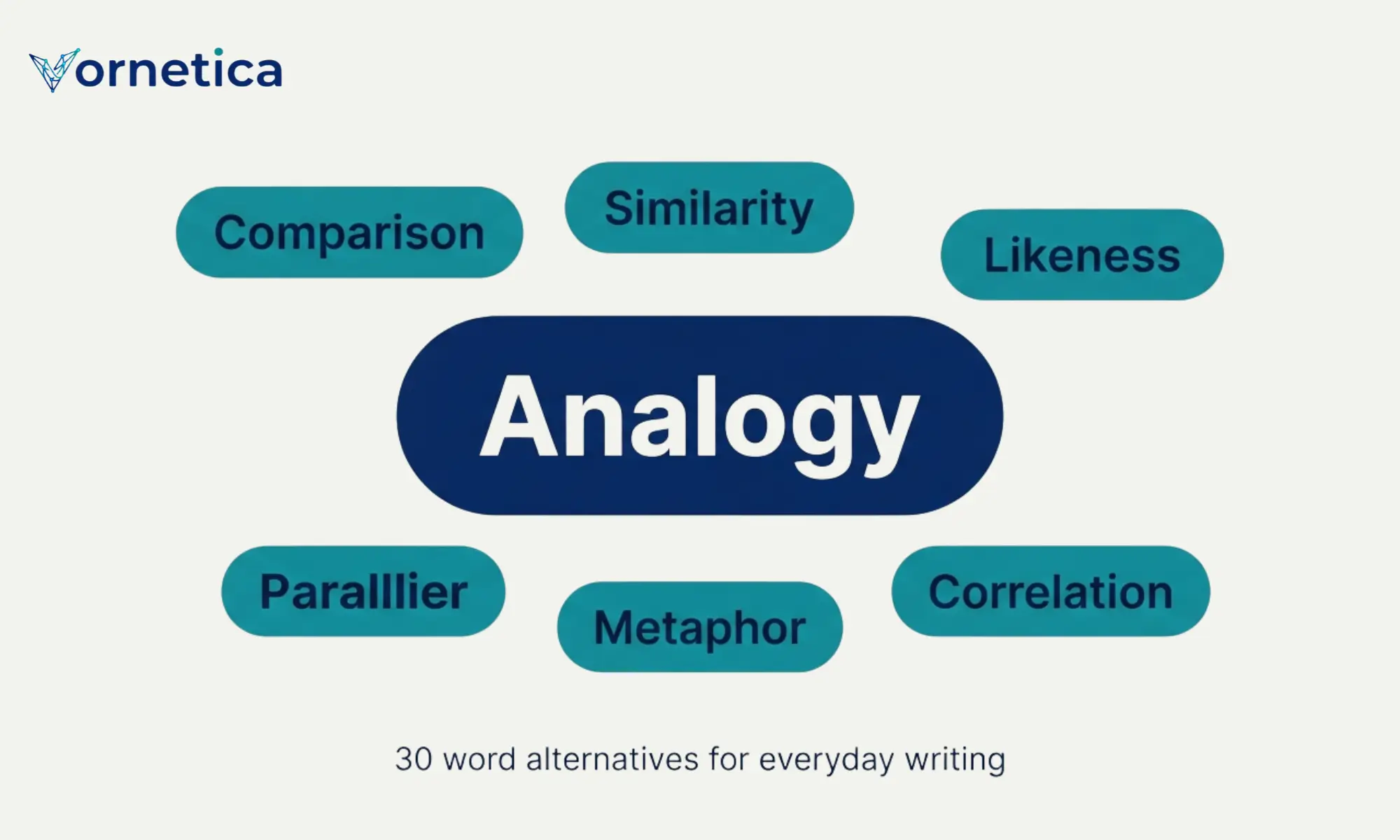
It helps us explain an idea in a clear and familiar way. Learning synonyms for analogy gives you more ways to talk about comparisons without repeating the same word.
Students can use these words in essays and schoolwork. Bloggers and content writers can use them to explain complex ideas more clearly.
Daily English users can also choose better words in conversations and messages.
Knowing synonyms for analogy can make your writing smoother, clearer, and more interesting.
Quick Answer Box
What is another word for analogy? Common synonyms include comparison, similarity, parallel, likeness, and correspondence. The best word depends on the type of comparison you want to make.
30 Synonyms for Analogy
1. Comparison
Meaning: A comparison shows how two things are alike or different.
Examples:
- The teacher made a comparison between a plant and a child.
- This comparison makes the idea easier to understand.
Best Used When: Use it in general, academic, and everyday writing.
2. Similarity
Meaning: Similarity means that two things are alike in some way.
Examples:
- I noticed a similarity between the two stories.
- Their ideas have a clear similarity.
Best Used When: Use it when focusing on shared features.
3. Parallel
Meaning: A parallel is a connection between two things that are similar.
Examples:
- The writer draws a parallel between school and work.
- We can see a parallel between the two events.
Best Used When: Use it in formal, academic, and literary writing.
4. Likeness
Meaning: Likeness means a way in which two things look or seem alike.
Examples:
- There is a strong likeness between the two paintings.
- She noticed a likeness between the brothers.
Best Used When: Use it when talking about appearance or shared qualities.
5. Correspondence
Meaning: Correspondence means a close match or connection between two things.
Examples:
- There is a clear correspondence between the two plans.
- The study found a correspondence between sleep and focus.
Best Used When: Use it in formal or technical writing.
6. Resemblance
Meaning: Resemblance means that two people or things are similar.
Examples:
- The child has a strong resemblance to her mother.
- I saw a resemblance between the two designs.
Best Used When: Use it for people, objects, designs, and visible similarities.
7. Connection
Meaning: A connection is a link between two ideas, things, or events.
Examples:
- The speaker made a connection between exercise and health.
- I can see a connection between these two examples.
Best Used When: Use it in everyday speech and general writing.
8. Association
Meaning: An association is a link between two ideas or things.
Examples:
- There is a strong association between rain and dark clouds.
- The writer creates an association between freedom and travel.
Best Used When: Use it in academic, formal, and professional writing.
9. Relationship
Meaning: A relationship is a way that two things are connected.
Examples:
- The lesson explains the relationship between food and energy.
- We studied the relationship between the two ideas.
Best Used When: Use it for ideas, people, events, and systems.
10. Link
Meaning: A link is a connection between two things.
Examples:
- The article shows a link between stress and poor sleep.
- She found a link between the two examples.
Best Used When: Use it in simple writing, reports, and everyday speech.
11. Affinity
Meaning: Affinity means a natural similarity or connection between things.
Examples:
- The two writers have an affinity for simple language.
- She felt an affinity with the group’s ideas.
Best Used When: Use it in formal or literary writing.
12. Equivalence
Meaning: Equivalence means that two things have the same value or meaning in some way.
Examples:
- The teacher explained the equivalence between the two terms.
- The chart shows an equivalence between the two values.
Best Used When: Use it in academic, mathematical, and technical contexts.
13. Correlation
Meaning: Correlation means that two things change or appear together in a related way.
Examples:
- The study found a correlation between exercise and better sleep.
- There is a strong correlation between the two results.
Best Used When: Use it mainly in research, science, and statistics.
14. Contrast
Meaning: Contrast shows how two things are different.
Examples:
- The writer uses contrast to explain the two ideas.
- The contrast between the teams was easy to see.
Best Used When: Use it when differences are more important than similarities.
15. Juxtaposition
Meaning: Juxtaposition means putting two different things close together to show a clear effect.
Examples:
- The painting uses a juxtaposition of light and dark.
- The story creates a strong juxtaposition between rich and poor.
Best Used When: Use it in literary, artistic, and creative writing.
16. Metaphor
Meaning: A metaphor describes one thing by saying it is another thing.
Examples:
- The writer uses a metaphor to describe time as a river.
- “Life is a journey” is a common metaphor.
Best Used When: Use it in creative writing, literature, and explanations.
17. Simile
Meaning: A simile compares two things using words such as “like” or “as.”
Examples:
- Her smile was like sunshine.
- The teacher used a simile to explain the idea.
Best Used When: Use it in stories, poems, and creative writing.
18. Illustration
Meaning: An illustration is an example that makes an idea easier to understand.
Examples:
- The teacher gave an illustration of the problem.
- This story is a useful illustration of teamwork.
Best Used When: Use it in teaching, essays, presentations, and explanations.
19. Example
Meaning: An example is something that shows what an idea means.
Examples:
- The teacher gave an example from daily life.
- This example makes the rule much clearer.
Best Used When: Use it in everyday, academic, and instructional writing.
20. Representation
Meaning: A representation is something that shows or stands for another thing.
Examples:
- The model is a representation of the human heart.
- The picture is a simple representation of the process.
Best Used When: Use it in academic, technical, and visual contexts.
21. Model
Meaning: A model is a simple form used to explain how something works.
Examples:
- The teacher used a model to explain the system.
- This model helps students understand the process.
Best Used When: Use it in science, education, business, and technical writing.
22. Prototype
Meaning: A prototype is an early model used to show how something may work.
Examples:
- The team built a prototype of the new device.
- The prototype helped us understand the final design.
Best Used When: Use it in product design, technology, and engineering.
23. Reflection
Meaning: A reflection is something that shows a similar idea or quality.
Examples:
- The story is a reflection of modern family life.
- His actions were a reflection of his values.
Best Used When: Use it in literary, personal, and reflective writing.
24. Echo
Meaning: An echo is a repeated idea, quality, or pattern from something else.
Examples:
- The new story has an echo of an old legend.
- Her speech had an echo of her teacher’s ideas.
Best Used When: Use it in creative, literary, and descriptive writing.
25. Comparison Point
Meaning: A comparison point is a feature used to compare two things.
Examples:
- Price is an important comparison point.
- The teacher gave us one comparison point for the two systems.
Best Used When: Use it in reports, reviews, and analytical writing.
26. Case
Meaning: A case is a real or imagined situation used to explain an idea.
Examples:
- The teacher shared a case from a real company.
- This case shows why planning matters.
Best Used When: Use it in business, education, research, and professional writing.
27. Scenario
Meaning: A scenario is a possible situation used to explain or test an idea.
Examples:
- Imagine a scenario where the internet stops working.
- This scenario helps us understand the problem.
Best Used When: Use it in teaching, planning, business, and technical writing.
28. Analogue
Meaning: An analogue is something that is similar to another thing and can help explain it.
Examples:
- The teacher used a simple analogue for the complex system.
- A map can serve as an analogue for a larger area.
Best Used When: Use it in formal, academic, and technical writing.
29. Comparison Model
Meaning: A comparison model is a simple structure used to show similarities between things.
Examples:
- The class used a comparison model to study the two systems.
- This comparison model makes the process easier to follow.
Best Used When: Use it in education, reports, and structured explanations.
30. Figurative Comparison
Meaning: A figurative comparison explains one idea by connecting it with another.
Examples:
- The writer uses a figurative comparison to explain fear.
- This figurative comparison makes the story more vivid.
Best Used When: Use it in creative writing, literature, and descriptive explanations.
Comparison Table
| Synonym | Tone | Best Used In |
| Comparison | Neutral | Writing, speech |
| Similarity | Neutral | Writing, speech |
| Parallel | Formal | Writing |
| Likeness | Neutral | Writing, speech |
| Correspondence | Formal | Technical, writing |
| Resemblance | Neutral | Writing, speech |
| Connection | Neutral | Writing, speech |
| Association | Formal | Technical, writing |
| Relationship | Neutral | Writing, speech |
| Link | Neutral | Writing, speech |
| Affinity | Formal | Writing |
| Equivalence | Formal | Technical, writing |
| Correlation | Formal | Technical, writing |
| Contrast | Neutral | Writing, speech |
| Juxtaposition | Formal | Creative writing |
| Metaphor | Neutral | Creative writing |
| Simile | Neutral | Creative writing |
| Illustration | Formal | Writing, speech |
| Example | Neutral | Writing, speech |
| Representation | Formal | Technical, writing |
| Model | Neutral | Technical, writing |
| Prototype | Formal | Technical, writing |
| Reflection | Neutral | Creative writing |
| Echo | Creative | Creative writing |
| Comparison Point | Neutral | Writing |
| Case | Neutral | Writing, speech |
| Scenario | Neutral | Writing, speech |
| Analogue | Formal | Technical, writing |
| Comparison Model | Formal | Technical, writing |
| Figurative Comparison | Formal | Creative writing |
Choosing the Right Synonym for Analogy
The best synonym depends on what you want to say.
Use comparison when you simply want to show how two things are alike or different. It is one of the safest choices for essays, blogs, and daily speech.
Use parallel when two situations, ideas, or events have a clear connection. It sounds more formal and often appears in academic or literary writing.
Use similarity, likeness, or resemblance when the main point is that two things share qualities. These words work well when talking about people, objects, designs, or ideas.
For science and research, words such as correlation, correspondence, and equivalence can be more precise. However, they do not always mean exactly the same thing as analogy.
Creative writers often choose metaphor, simile, echo, or figurative comparison. These words can help explain ideas through images and familiar situations.
For example, a blogger might compare learning vocabulary to building a house. Each new word becomes another useful tool. If you want to describe movement in a story, you may also explore synonyms for teleport to find a more suitable word.
Remember that synonyms are not always perfect replacements. Always check the sentence before changing one word for another.
A simple comparison can also make instructions easier to understand. If you are explaining how to open or understand something, you may find synonyms for unlock useful for choosing a more exact word.
Good vocabulary is not about using the hardest word. It is about choosing the word that gives your reader the clearest meaning.
Frequently Asked Questions
What is another word for analogy?
Common words include comparison, similarity, parallel, likeness, and correspondence. The right choice depends on the context.
Is comparison a synonym for analogy?
Yes, comparison is one of the closest general synonyms for analogy. Both words can describe similarities between two things.
What is the difference between analogy and metaphor?
An analogy explains an idea by comparing it with another idea. A metaphor directly describes one thing as another thing.
What is a simple example of an analogy?
Saying “The brain is like a computer” is a simple analogy. It compares the brain with a familiar object to explain how it works.
Why are analogies useful in writing?
Analogies make difficult ideas easier to understand. They can also make essays, blogs, stories, and explanations more interesting.
Practice Exercise
Fill in each blank with the best synonym from the list above.
- The teacher made a clear _________ between the brain and a computer.
- The study found a strong _________ between exercise and better sleep.
- “Life is a journey” is a common _________.
- The two paintings have a clear _________ in their style.
- The speaker used a real-life _________ to explain the difficult idea.
Answer Key
- Comparison
- Correlation
- Metaphor
- Similarity
- Example
Key Takeaways
- Comparison is the most general synonym for analogy.
- Parallel works well for connected ideas or situations.
- Similarity, likeness, and resemblance focus on shared qualities.
- Correlation is useful in research and technical writing.
- Metaphor and simile are common in creative writing.
- Choose a synonym based on the exact meaning and context, not just because the words look similar.
Another useful vocabulary skill is knowing when a simple word sounds better than a formal one. For example, a writer may choose “win” in everyday language instead of a more formal phrase. You can explore synonyms for win when you need more choices.
When explaining ideas in a conversation, the same rule applies. Choose a word that your listener will understand quickly. If a conversation becomes too long or repetitive, vocabulary choices can also help you describe that style more clearly. For more related vocabulary, see synonyms for yapping.
You can also use comparison words in stories and everyday actions. A small detail, such as someone waving to a friend, can become part of a useful comparison in a story. For more vocabulary options, check synonyms for waving.
Conclusion
Learning synonyms for analogy gives you more ways to explain ideas, compare things, and make your writing clearer.
These words can improve essays, blog posts, emails, stories, and daily conversations.
Practice using comparison words in simple sentences first. Then try them in emails, essays, and everyday conversations.
With regular practice, you will learn which word fits each situation best. Keep building your vocabulary by searching for another useful word on the site.