Have you ever looked at a hard code, old note, or confusing message and thought, “What does this mean?” You may need to decipher it.
To decipher something means to understand or work out its meaning when it is hard to read or understand.
For example, a student may decipher a difficult sentence by reading it slowly. A detective may decipher a hidden message to solve a case.
Knowing synonyms for decipher can help you choose better words for different situations. Students can use them in essays.
Bloggers and content writers can use them to avoid repeated words. Daily English users can also speak and write more clearly.
Learning synonyms for decipher gives you more ways to describe the act of finding meaning, solving something, or making unclear information easier to understand.
Quick Answer Box:
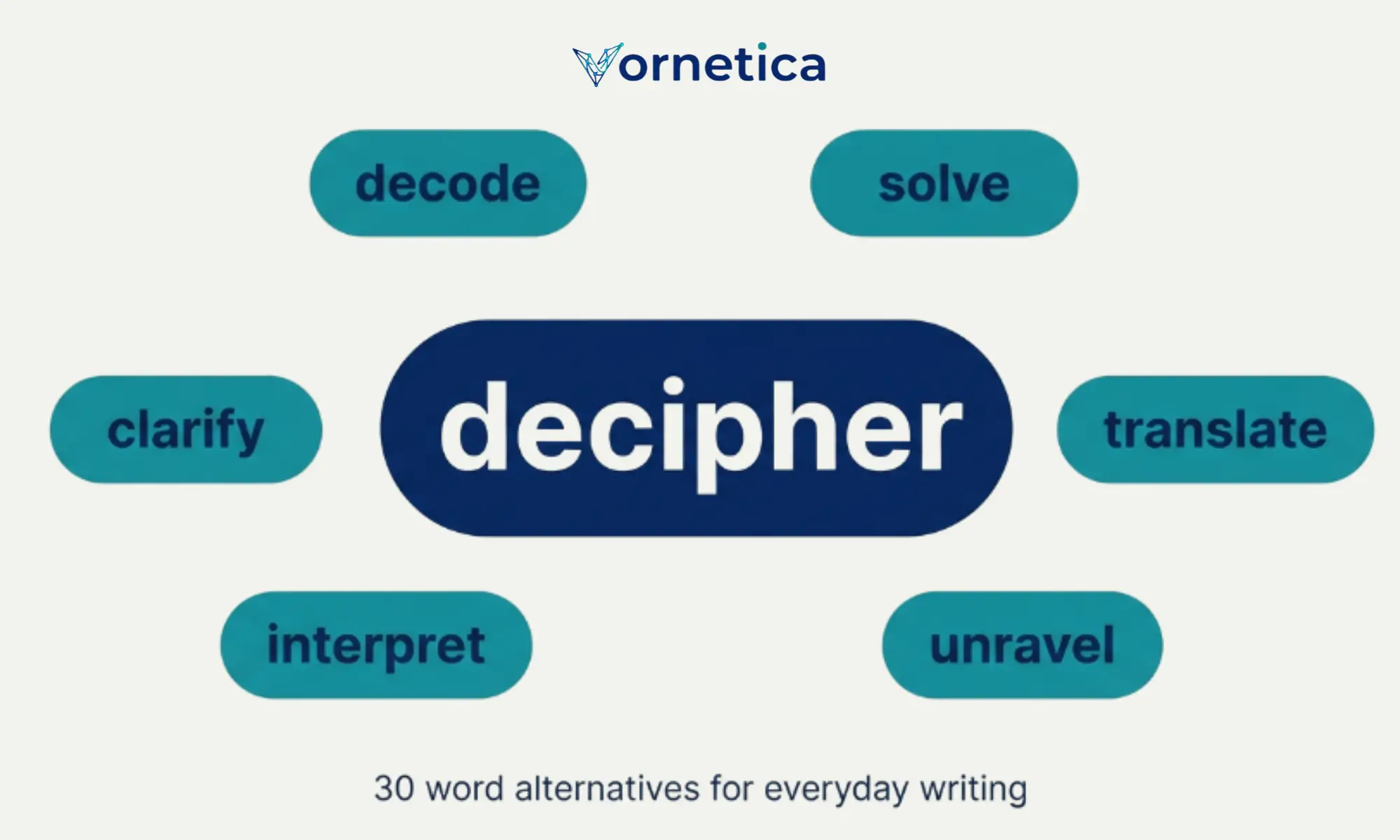
Another word for decipher is decode, interpret, understand, figure out, or unravel. These are common choices when you need to describe finding the meaning of something difficult or unclear.
Decode
Meaning: Decode means to change a secret or coded message into a form you can understand.
Examples:
- The spy tried to decode the secret message.
- Can you decode this strange symbol?
Best Used When: Use it for codes, signals, symbols, and secret messages.
Interpret
Meaning: Interpret means to explain the meaning of something.
Examples:
- She helped me interpret the poem.
- The teacher asked us to interpret the graph.
Best Used When: Best for formal writing, literature, speech, and data.
Understand
Meaning: Understand means to know what something means.
Examples:
- I finally understand the question.
- Do you understand what he said?
Best Used When: Use it in everyday speech and simple writing.
Figure Out
Meaning: Figure out means to find the answer or understand something.
Examples:
- I need to figure out this math problem.
- We finally figured out how the machine works.
Best Used When: Best for casual speech and friendly writing.
Unravel
Meaning: Unravel means to slowly solve or understand something confusing.
Examples:
- The detective began to unravel the mystery.
- We need time to unravel the problem.
Best Used When: Good for mysteries, stories, problems, and creative writing.
Comprehend
Meaning: Comprehend means to fully understand something.
Examples:
- I could not comprehend the long report.
- She read the text twice to comprehend it.
Best Used When: Best for formal, academic, and educational writing.
Solve
Meaning: Solve means to find the answer to a problem or mystery.
Examples:
- We worked together to solve the puzzle.
- The detective solved the case.
Best Used When: Use it for problems, puzzles, cases, and challenges.
Crack
Meaning: Crack means to successfully solve something that is difficult.
Examples:
- The team cracked the secret code.
- She finally cracked the puzzle.
Best Used When: Best for casual speech, puzzles, codes, and mysteries.
Analyze
Meaning: Analyze means to study something carefully to understand it.
Examples:
- We need to analyze the data.
- The student analyzed the poem.
Best Used When: Use it in academic, business, and technical writing.
Make Sense Of
Meaning: Make sense of means to understand something confusing.
Examples:
- I cannot make sense of this note.
- He helped me make sense of the instructions.
Best Used When: Best for everyday speech and informal writing.
Discern
Meaning: Discern means to notice or understand something that is not easy to see.
Examples:
- I could barely discern the words.
- She discerned a change in his voice.
Best Used When: Best for formal writing and careful observation.
Determine
Meaning: Determine means to find or decide the exact answer.
Examples:
- We must determine the cause of the problem.
- The test helped determine the correct answer.
Best Used When: Best for formal, academic, and professional writing.
Untangle
Meaning: Untangle means to make a confusing problem clear.
Examples:
- She helped untangle the confusing story.
- We need to untangle these details first.
Best Used When: Good for complicated ideas, stories, and problems.
Clarify
Meaning: Clarify means to make something easier to understand.
Examples:
- Could you clarify your question?
- The teacher clarified the difficult point.
Best Used When: Best for emails, schoolwork, business, and formal speech.
Explain
Meaning: Explain means to make an idea or meaning clear to someone.
Examples:
- Can you explain this word?
- Dad explained how the tool works.
Best Used When: Use it in almost any everyday or formal situation.
Construe
Meaning: Construe means to understand something in a particular way.
Examples:
- Do not construe his silence as anger.
- Her words were construed as a warning.
Best Used When: Best for formal, legal, and academic writing.
Demystify
Meaning: Demystify means to make something mysterious or difficult easier to understand.
Examples:
- The guide helps demystify complex grammar.
- The teacher demystified the hard topic.
Best Used When: Great for educational, blog, and explanatory content.
For example, vocabulary writers often need clear language when explaining how words change meaning. If you are studying other word forms, you can also explore synonyms for become for more vocabulary ideas.
Elucidate
Meaning: Elucidate means to explain something clearly.
Examples:
- The professor elucidated the main idea.
- This chart elucidates the process.
Best Used When: Best for formal, academic, and professional writing.
Explicate
Meaning: Explicate means to explain an idea or text in detail.
Examples:
- The teacher explicated the poem.
- The essay explicates the writer’s main point.
Best Used When: Best for academic and literary writing.
Parse
Meaning: Parse means to examine words or parts carefully to understand them.
Examples:
- The student parsed the difficult sentence.
- We parsed the message word by word.
Best Used When: Best for grammar, language study, and computer-related contexts.
Fathom
Meaning: Fathom means to understand something that is very difficult.
Examples:
- I cannot fathom why he left.
- She struggled to fathom the strange decision.
Best Used When: Use it for difficult ideas, feelings, or situations.
Grasp
Meaning: Grasp means to understand an idea clearly.
Examples:
- I quickly grasped the main idea.
- He did not grasp the meaning of the joke.
Best Used When: Best for everyday, academic, and workplace communication.
Glean
Meaning: Glean means to learn or find information from careful reading or observation.
Examples:
- I gleaned useful facts from the report.
- She gleaned the answer from his notes.
Best Used When: Best for formal writing and research contexts.
Identify
Meaning: Identify means to recognize or find exactly what something is.
Examples:
- We need to identify the hidden symbol.
- She identified the main problem quickly.
Best Used When: Use it for finding details, problems, people, or objects.
Uncover
Meaning: Uncover means to discover something that was hidden or unknown.
Examples:
- The reporter uncovered new facts.
- We uncovered the truth behind the message.
Best Used When: Best for research, investigations, mysteries, and news writing.
Reveal
Meaning: Reveal means to make hidden information known.
Examples:
- The letter revealed the truth.
- The test revealed a serious mistake.
Best Used When: Use it for hidden facts, secrets, and discoveries.
Discover
Meaning: Discover means to find something that was not known before.
Examples:
- We discovered the meaning of the old note.
- She discovered a useful clue.
Best Used When: Best for general writing, research, and everyday speech.
Read
Meaning: Read can mean to understand written words or information.
Examples:
- Can you read this old handwriting?
- I could not read the faded message.
Best Used When: Best for simple everyday speech and written communication.
Translate
Meaning: Translate means to change words from one language into another.
Examples:
- Can you translate this sentence into English?
- She translated the note for me.
Best Used When: Best for languages and multilingual communication.
Decode
Meaning: Decode means to understand information that is written in a code or special form.
Examples:
- The computer decoded the signal.
- They decoded the message in minutes.
Best Used When: Best for codes, technology, signals, and secret messages.
Note: “Decode” is closely related to decipher, but it is especially useful when the information uses a code, cipher, or special system.
Interpret
Meaning: Interpret means to work out what words, signs, actions, or information mean.
Examples:
- She interpreted his smile as a friendly sign.
- We interpreted the results carefully.
Best Used When: Best for signs, behavior, literature, and information.
Vocabulary tip: Choosing the right synonym depends on context. For example, decode often points to a code, while interpret can refer to meaning, behavior, art, or language.
If you are building a larger vocabulary site, related pages can help readers move naturally from one word to another. For example, synonyms for born can support readers who want to learn more common vocabulary.
Penetrate
Meaning: Penetrate can mean to understand something that is hard to understand.
Examples:
- Few people could penetrate the mystery.
- She tried to penetrate his hidden meaning.
Best Used When: Best for formal or literary writing.
Comprehend
Meaning: Comprehend means to understand something fully.
Examples:
- He could not comprehend the strange message.
- The class worked hard to comprehend the text.
Best Used When: Best for formal and academic writing.
Note: “Comprehend” is very close to “understand,” but it often sounds more formal.
Comparison Table
| Synonym | Tone (Formal/Neutral/Casual) | Best Used In (writing/speech/technical) |
| Decode | Neutral | Technical, writing |
| Interpret | Formal | Writing, speech |
| Understand | Neutral | Speech, writing |
| Figure Out | Casual | Speech |
| Unravel | Neutral | Writing, creative |
| Comprehend | Formal | Academic writing |
| Solve | Neutral | Speech, writing |
| Crack | Casual | Speech, creative |
| Analyze | Formal | Academic, technical |
| Make Sense Of | Casual | Speech, writing |
| Discern | Formal | Writing |
| Determine | Formal | Writing, technical |
| Untangle | Neutral | Writing, speech |
| Clarify | Formal | Writing, speech |
| Explain | Neutral | Writing, speech |
| Construe | Formal | Academic, legal |
| Demystify | Neutral | Writing, educational |
| Elucidate | Formal | Academic writing |
| Explicate | Formal | Academic writing |
| Parse | Formal | Technical, language |
| Fathom | Neutral | Speech, creative |
| Grasp | Neutral | Speech, writing |
| Glean | Formal | Research, writing |
| Identify | Neutral | Writing, technical |
| Uncover | Neutral | Writing, research |
| Reveal | Neutral | Writing, speech |
| Discover | Neutral | Writing, speech |
| Read | Neutral | Speech, writing |
| Translate | Neutral | Technical, language |
| Penetrate | Formal | Creative, formal |
When comparing words, it also helps to notice how meaning changes with context. A word such as cascade, for example, has a different sense from “decipher,” so checking a dedicated synonyms for cascade page can help you learn it in context.
Frequently Asked Questions
What is another word for decipher?
Another word for decipher is decode, interpret, understand, figure out, or unravel.
What does decipher mean?
Decipher means to understand something that is hard to read, understand, or explain.
What is the best synonym for decipher?
Decode is one of the best synonyms when talking about codes or secret messages. Interpret works well for meaning, signs, and ideas.
Is decipher formal or informal?
“Decipher” is a neutral word that works in both formal and everyday English.
What is the difference between decipher and decode?
Decipher often means working out something difficult or unclear. Decode is more specific to codes, signals, or coded messages.
Practice Exercise
Fill in each blank with the best synonym from the list.
- The detective tried to __________ the secret message.
- Can you __________ what this old handwriting says?
- The teacher helped us __________ the difficult poem.
- We finally __________ the answer to the puzzle.
- The report helped __________ the cause of the problem.
Answer Key
- decode
- read
- interpret
- solve
- determine
Key Takeaways
Remember these useful points:
- Decode is great for codes, signals, and secret messages.
- Interpret works well for meaning, signs, art, and information.
- Understand is the easiest everyday synonym for decipher.
- Figure out is useful in casual conversations.
- Unravel works well for mysteries and confusing problems.
- Choose a synonym based on the context, not just the basic meaning.
For readers who enjoy building vocabulary step by step, words from related synonym pages can also make practice more useful. You can explore synonyms for complain to see how small changes in word choice can improve everyday English.
Conclusion
Learning synonyms for decipher gives you more ways to express the idea of understanding, solving, or explaining something difficult.
Words like decode, interpret, grasp, unravel, and figure out can make your writing and speech more natural.
Try these words in emails, essays, blog posts, and daily conversations. Practice one new synonym each day and notice how its meaning fits different situations.
When you want to improve your vocabulary, search for another word on the site and keep learning.